Séville v. Chrétien
The standard history of early Louisiana is written from the desks of white planters and the benches of corrupt judges. When historians do look at the archives of St. Landry Parish, they usually focus on the tragic, rigged timeline of the Seville versus Chretien freedom suit of 1817, a case where a Creole family won their liberty only to have a former defense attorney turned judge snatch it back a decade later. But if you look past the official rulings, a completely different, untold story emerges from the dust of the Opelousas courthouse. This is not a tragedy about the absolute power of the planter elite. It is a story about a sophisticated, highly coordinated underground network of Creole families who weaponized the law, preserved their ancestral memories across generations, and mounted a multi-front legal strike that terrified the Louisiana establishment.
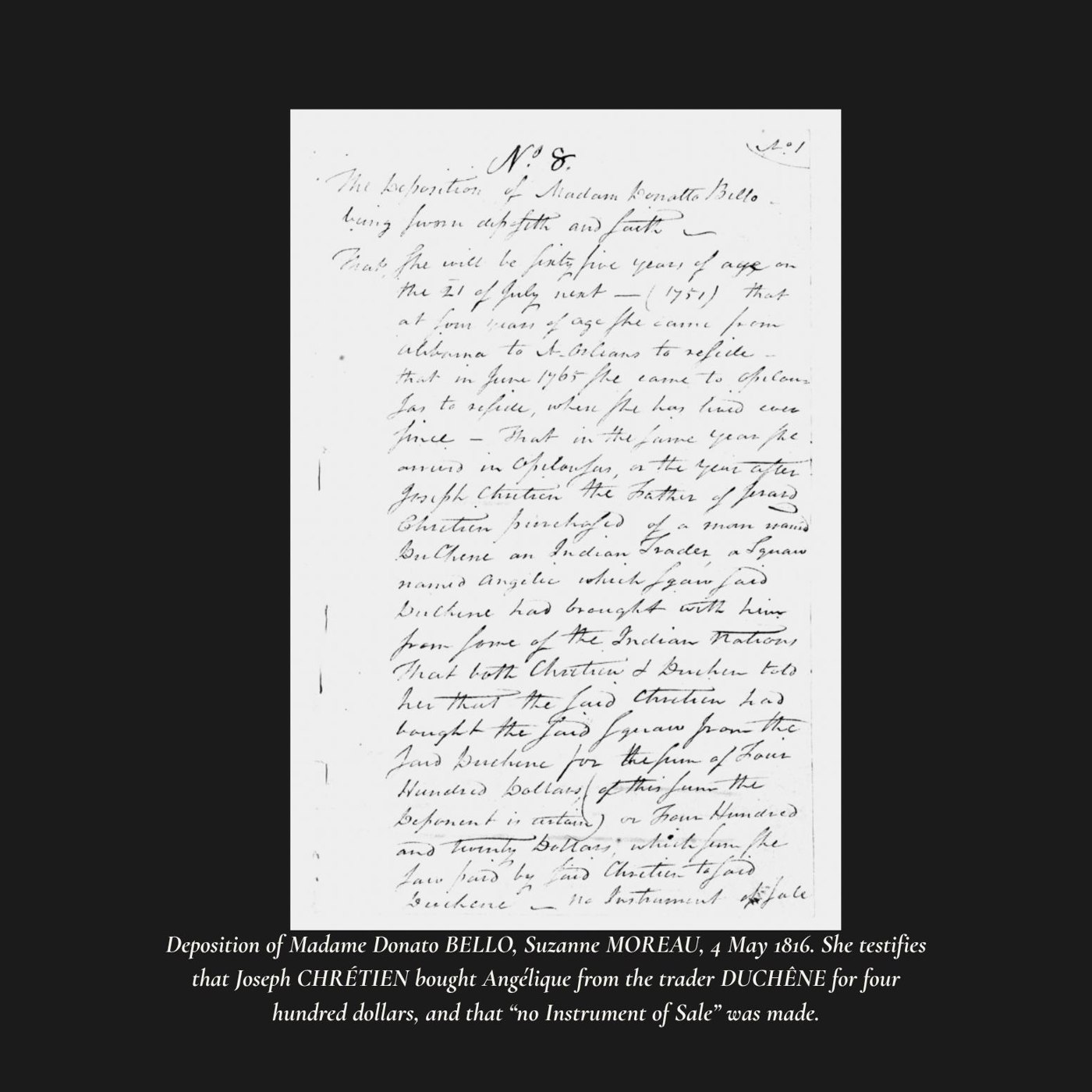
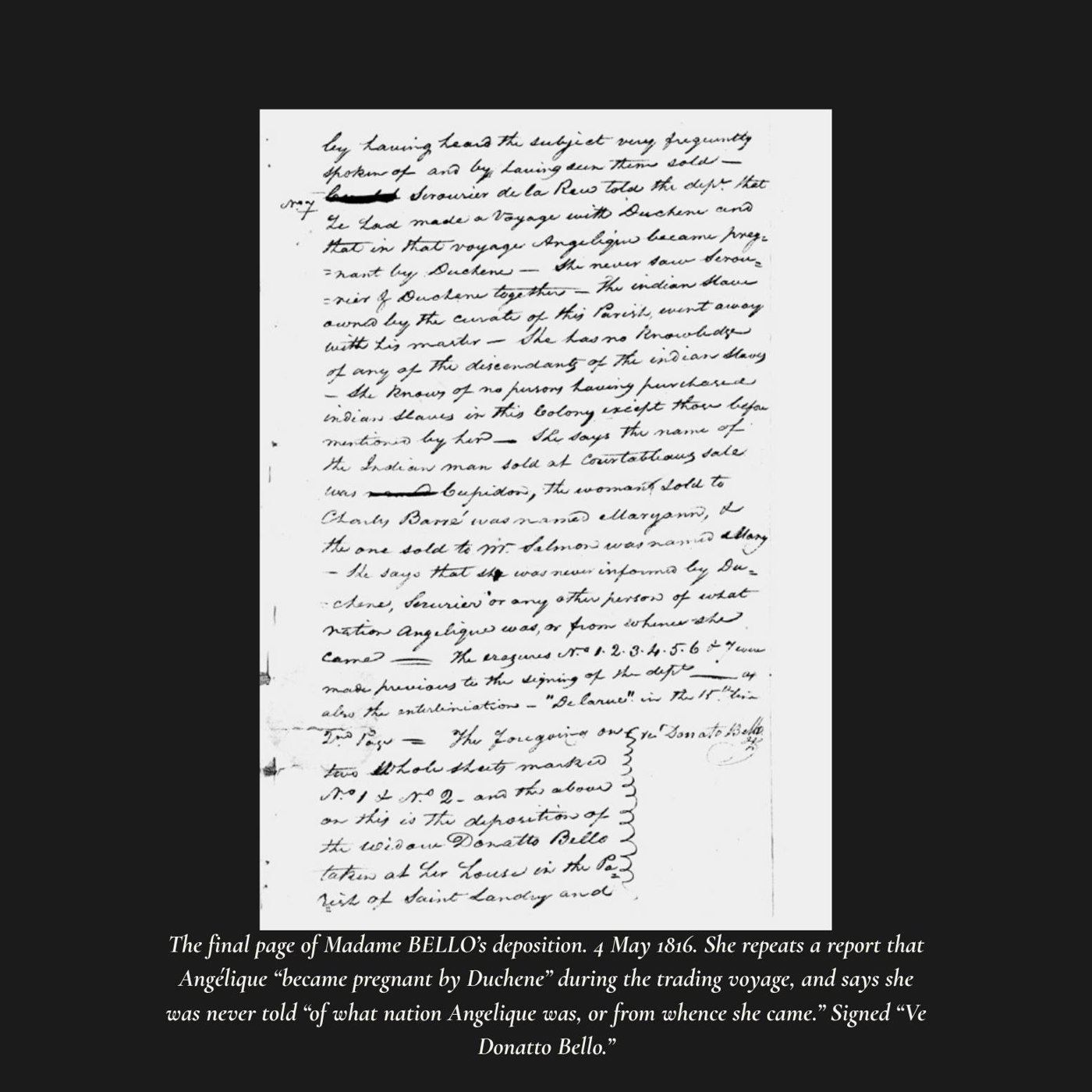
The legal battle began around 1765 at the colonial Opelousas post when a trader named Duchene sold an Indigenous woman named Angelique to a wealthy planter named Joseph Chretien for four hundred silver dollars. Because no bill of sale was ever recorded, her enslavers relied on a convenient fiction that she was a Pani, a generic catch-all term French colonists used for any captive taken from the Western frontier. But Angelique was not a nameless captive from a legal void. Her journey began along the Red River frontier, a dynamic and fiercely contested borderland between Spanish Texas and French Louisiana. This region was the sovereign territory of the Caddo Confederacy and the Wichita nations. Angelique carried the geography, languages, and lineages of these sophisticated multi-tribal networks down to the bayous of St. Landry Parish. Though her captors tried to erase her specific nationhood, they could not erase her humanity. On that very trading voyage, Duchene forced himself upon her, and she gave birth to a daughter named Agnes. Agnes grew up with the full knowledge of who her mother was, where she came from, and why her bondage was entirely illegal under Spanish and French colonial law.
For decades, the Chretien family believed they had successfully absorbed Angelique’s descendants into the fabric of plantation slavery. They were wrong. Behind the closed doors of slave quarters and across separate households, Angelique’s children and grandchildren were keeping records.
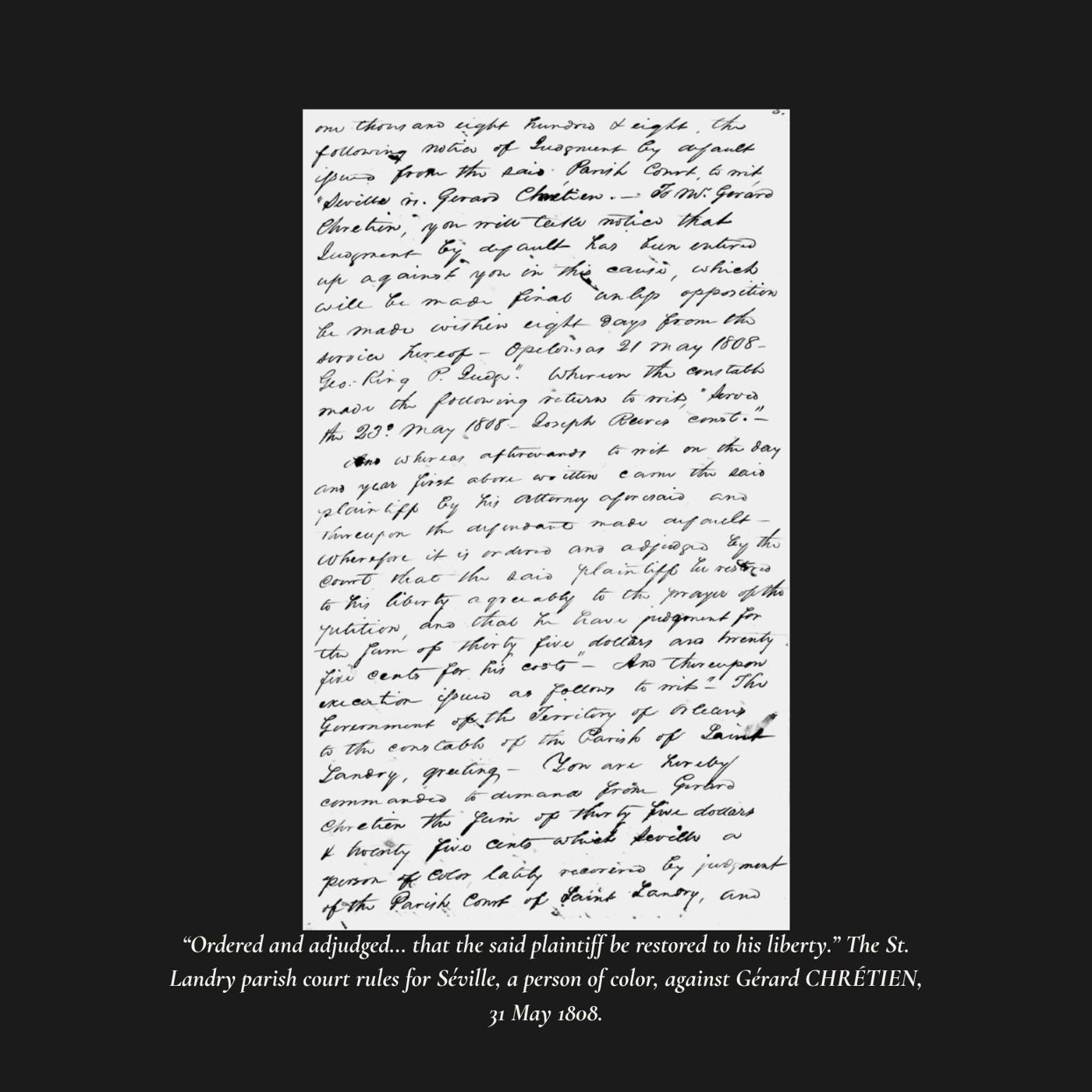
They passed down oral histories, tracked the names of witnesses who saw the exchange in 1765, and waited for the perfect moment to strike. That moment came in December 1807, during the chaotic transition from Spanish colonial rule to the American territorial government. Planters suddenly found themselves facing seven separate, simultaneous lawsuits from seven different Creole individuals, all held by different masters, all claiming descent from the exact same matriarch, Angelique. This was not a series of isolated, desperate legal pleas. This was a massive, highly organized political maneuver. Seville and his cousins had been secretly meeting across plantation lines, pooling information, and coordinating their legal strategy to hit the St. Landry Parish elite all at once. The strategy worked. In May 1808, the parish court ordered Seville and four of his relatives restored to their liberty.
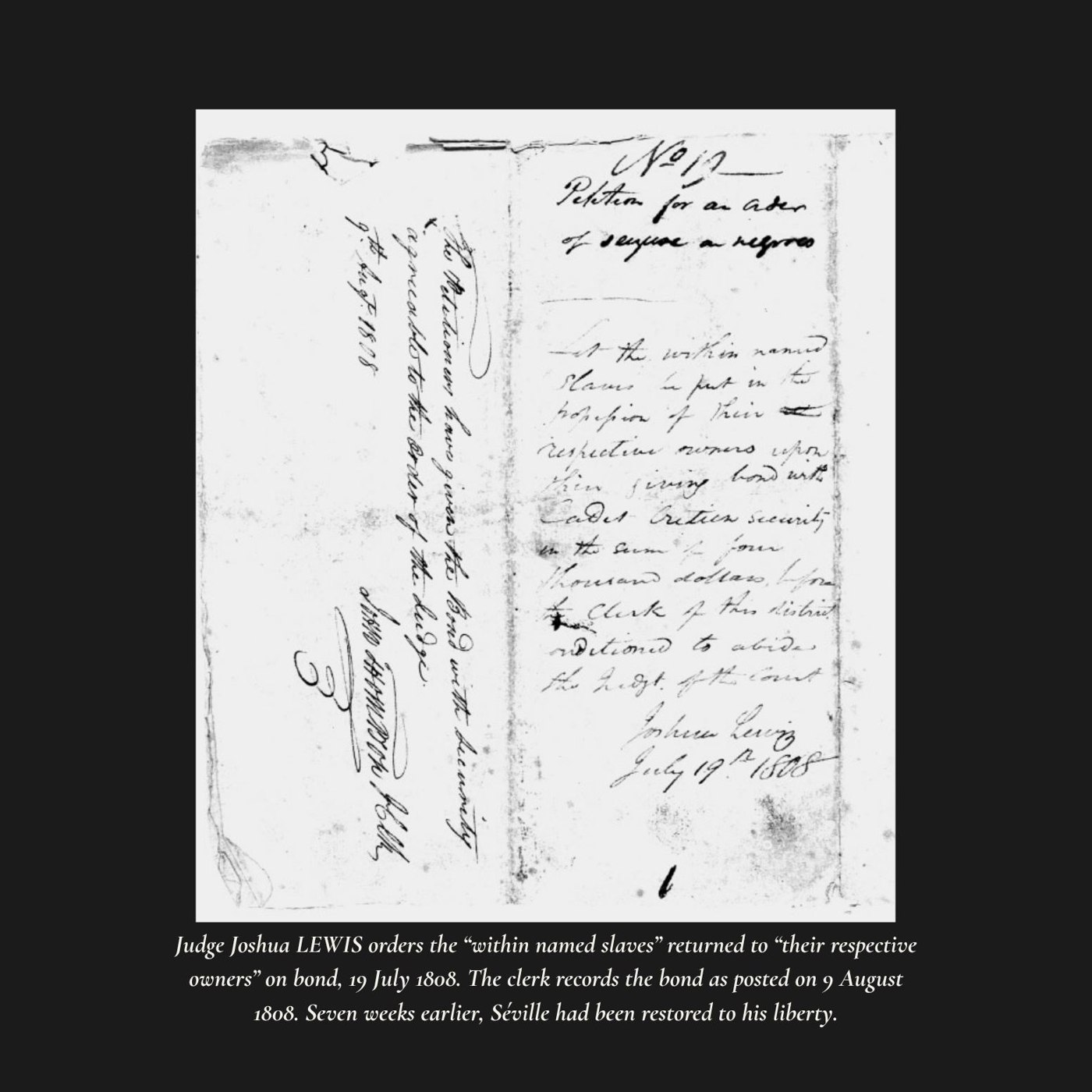
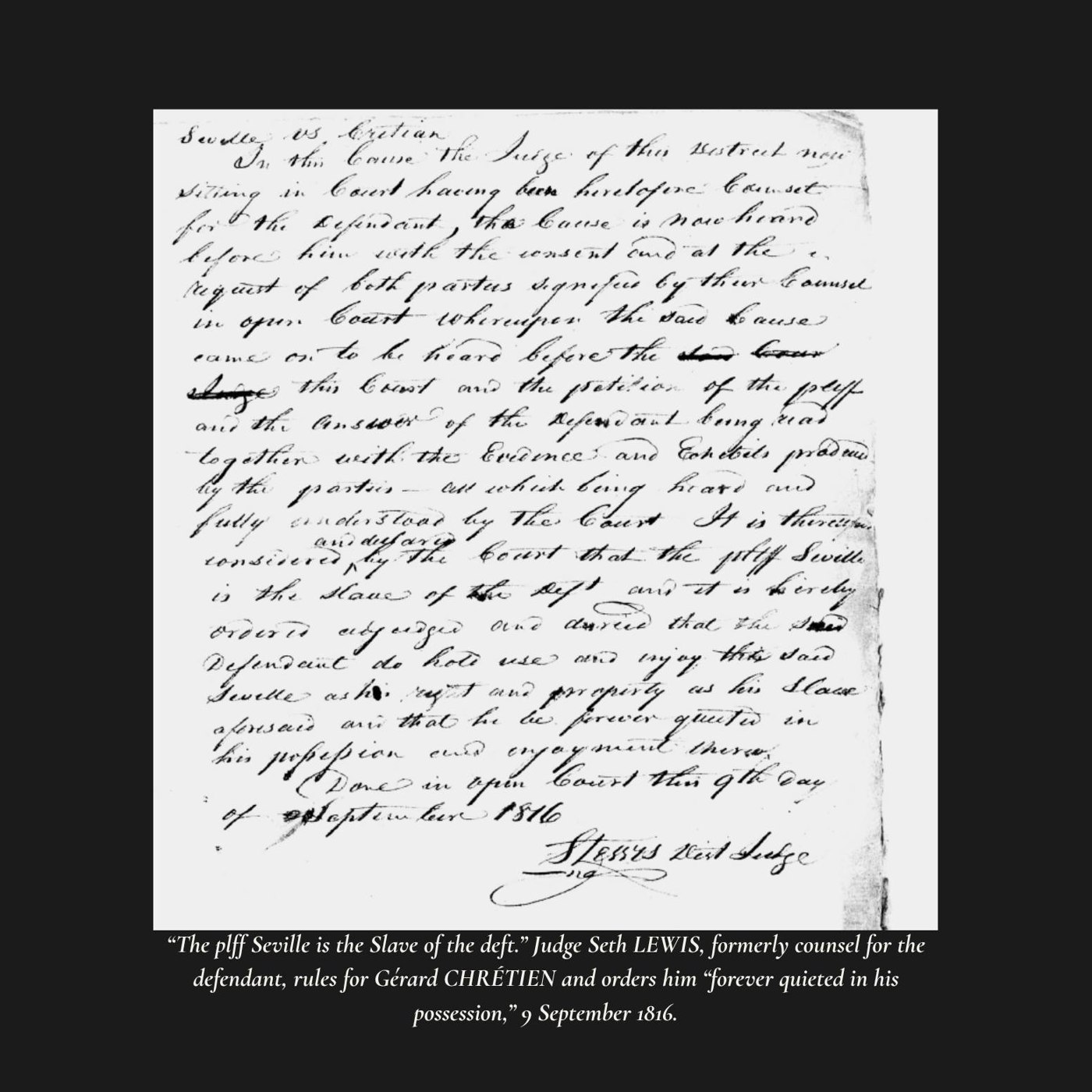
The panic among the white planter class was instantaneous. If Seville was legally free because of his Indigenous maternal ancestor, then thousands of mixed-heritage Creoles across Louisiana had the exact same right to walk away from the fields. The Chretiens petitioned the territorial court to immediately seize the family, terrified they would flee. To defeat this Creole coalition, the state had to change the rules of the game. They did not just rig the court by transferring the case 130 miles away to a judge who used to be the Chretiens' lawyer. They used bureaucratic warfare to systematically change how the family was defined. Over three generations, the ink in the ledger books deliberately shifted from labeling Angelique as an Indigenous woman, to her daughter Agnes as a mixed-heritage metisse, and finally to Seville as a person of color. This was a deliberate strategy by the newly dominant Anglo-American regime to flatten Louisiana’s complex three-tiered colonial structure into a rigid binary system of white over Black. By erasing Seville's Indigenous legal identity and reclassifying him simply as a person of color, the courts protected the financial survival of the plantation economy. When the Louisiana Supreme Court ultimately ruled against Seville in 1817, they admitted they could not find a single French or Spanish law that ever made Indigenous slavery legal. They ruled based on custom, the collective, self-serving memory of aging enslavers.
The traditional history books tell you that Seville lost. But the docket tells a grander story of resistance. It shows that Angelique’s descendants refused to let their ancestry be quietly erased. They forced the highest authorities in Louisiana to scour archives all the way to France, exposing the legal bankruptcy of the entire slaveholding system. Seville, Agnes, and Angelique did not just endure the archive, they dictated it. They left a permanent paper trail proving that the Creole community of Louisiana was never just a passive population waiting for freedom; they were legal strategists, keepers of the flame, and organizers who shook the foundations of the territory.
Sources and Citations:
Louisiana Supreme Court Archives: Séville, f.p.c., v. Chrétien, Docket 34, Western District, Alexandria session, September 1817. Filed under MSS 106, Historic Archives of the Louisiana Supreme Court, Louisiana and Special Collections Department, Earl K. Long Library, University of New Orleans.
Published Legal Opinions: Séville v. Chrétien, 5 Mart. (o.s.) 275 (La. 1817). This publication outlines the final arguments regarding colonial custom, the lack of explicit French or Spanish statutory laws codifying Indigenous enslavement, and the ultimate ruling of the Louisiana Supreme Court.
St. Landry Parish Court Records: Original 1807–1808 dockets, petitions, and trial testimonies for Séville and his six relatives, housed at the St. Landry Parish Clerk of Court Archives in Opelousas, Louisiana. These records contain the localized depositions of witnesses like Madame Donato Bello (Suzanne Moreau) regarding the 1765 trade at the Opelousas post.
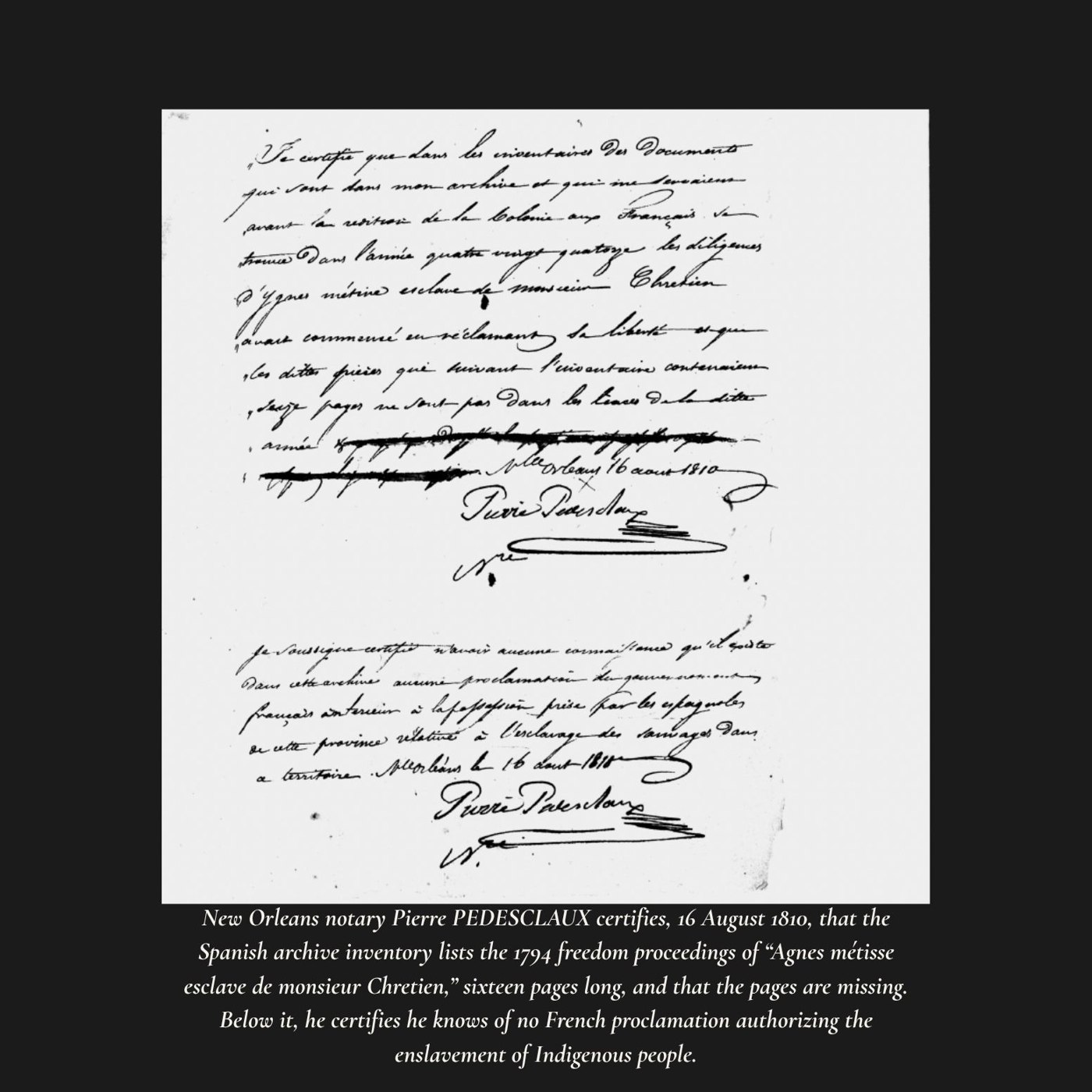
Spanish Colonial Archives: Inventory entries from 1794 outlining the original sixteen-page legal proceedings initiated by Agnès under Spanish rule, identifying her earlier attempt to secure liberty before the American transition.
Historical Context on the Red River Frontier: Barr, Juliana. Peace Came in the Form of a Woman: Indians and Spaniards in the Texas Borderlands. Chapel Hill: University of North Carolina Press,
2007. This text provides the foundational framework for the multi-tribal trading networks, captive exchanges, and relationships involving the Caddo, Wichita, and French traders along the Red River and Natchitoches frontiers during the mid-to-late 18th century.
Document credit: @[61582674785923:2048:The Kinstructure Company LLC]
First shared on Facebook, November 6, 2026.
The Documents
Sources
Séville v. Chrétien, 5 Mart. (o.s.) 275 (La. 1817) — the printed opinion, Martin’s Reports, Old Series vol. 5, pp. 275–291 (document in hand).
Louisiana Supreme Court Historical Archives, Earl K. Long Library, University of New Orleans, MSS 106, Docket 34 — the case file from which the handwritten pages above were photographed and published by The Kinstructure Company LLC (November 2026).
Researched from the original records. Prepared with the help of AI — the documents, the citations, and the history are real.
The documented work is shared as it surfaces on Facebook.
© 2026 Clayton Antwan Williams. All rights reserved.