The Donato Brothers and the St. Landry Progress
Let's talk about it. If your family comes out of Mallet, Plaisance, Grand Coteau, Prairie Basse, Washington, or Opelousas, I want to ask you something straight up. Did your grandparents or great-grandparents ever talk about la chasse à la jambe noire—the Blackleg Hunt—or what happened in St. Landry Parish back in September 1868?
Over 150 years ago, two weeks of terror rolled through that parish and left somewhere between two and three hundred Black and Creole people dead. History books call it the Opelousas Massacre, yet for a tragedy that big, the official records barely hold a single name. Even when St. Landry Parish marked the 150th anniversary, only a few descendant lines like the Auzennes, Barnebés, Clementines, and Mayfields were publicly recognized. Nobody has really traced those two weeks through our Creole family bloodlines or gathered the stories from the rural enclaves where people simply vanished.
It all started building earlier that September when Black and Creole residents tried to attend a political gathering in Washington, Louisiana, and white supremacist groups—the Knights of the White Camelia and the Seymour Knights—violently ran them off. Black and Creole men had just won the right to vote and were organizing ahead of the November presidential election, and those vigilantes were determined to break that momentum. On the morning of September 28, 1868, three white men walked into an Opelousas schoolhouse and beat eighteen-year-old schoolteacher and newspaper editor Emerson Bentley with a cane. Bentley survived and got away, though word tore across the parish that he had been murdered.
Sworn statements sitting in the U.S. Congressional record and the 1869 Louisiana legislative investigation put our own Donato family right in the middle of that first day. As Bentley made his way back toward town after the beating, he ran into F. J. D'Avy alongside Gustave Donato and his cousin Cornelius Donato. Gustave and his brother François Auguste Donato Jr. had founded and owned the building housing Bentley's bilingual English-and-French Republican paper, The St. Landry Progress. Together with Cornelius and D'Avy, they tried to get ahead of the storm—drafting a telegram to the governor and sending riders out into the country to warn folks what was coming.
It was already too late to stop it. Armed white mobs hit the St. Landry Progress office at Littell and Main, smashed the printing press, and dumped the pieces into Bayou Tesson. They killed co-editor C. E. Durand and left his body lying outside an Opelousas drugstore as a warning. Around that same time, roughly two dozen armed Black and Creole men had gathered northeast of Opelousas on the property of free-born Creole landowner Hilaire Paillet to check on Bentley and protect their neighbors. After a standoff with deputized white horsemen, twenty-nine men were arrested and locked in the Opelousas jail. The very next night, September 29, a lynch mob walked straight into that jail with the help of local law enforcement, pulled twenty-seven of those prisoners out, and shot them. Nobody ever wrote down a jail roster of the dead.
For the next fourteen days, armed bands rode through the rural wards hunting men down in their fields, in their houses, and in the woods. Freedmen's Bureau agents stationed in St. Landry reported that parish officials flat-out refused to investigate any of the rural killings. Bodies were left lying in the woods or buried in unmarked shallow graves along the bayous and coulees. Hundreds of people came up missing. Some were killed out in the country with nobody there to witness it, while others packed up in the middle of the night and fled the parish, leaving land and livestock behind just to stay alive. The folks who stayed were disarmed and forced to wear red flannel ribbons on their arms to prove they had submitted. By the time November rolled around, not a single Republican vote was cast in St. Landry Parish.
Two years later, in April 1870, Gustave and Auguste Donato took the town of Opelousas to court for fifteen thousand dollars over the destruction of their property, and both Gustave and Cornelius gave sworn statements to federal investigators so the truth wouldn't get buried completely. Still, back home in the parish, talking out loud about who got taken or where bodies were hidden carried the threat of retaliation for generations.
Paper records can only carry us so far. To really honor the people who lived through September 1868, we have to turn to the memories kept alive inside our own families. Did your elders ever mention the red arm ribbons, the night rides, or what happened in 1868? Do you have family stories about an ancestor who disappeared between the 1867 voter rolls and the 1870 census, or a relative who left St. Landry Parish overnight? Share what was passed down to you. Every piece of oral history helps put a name back where the records left a blank.
The Documents
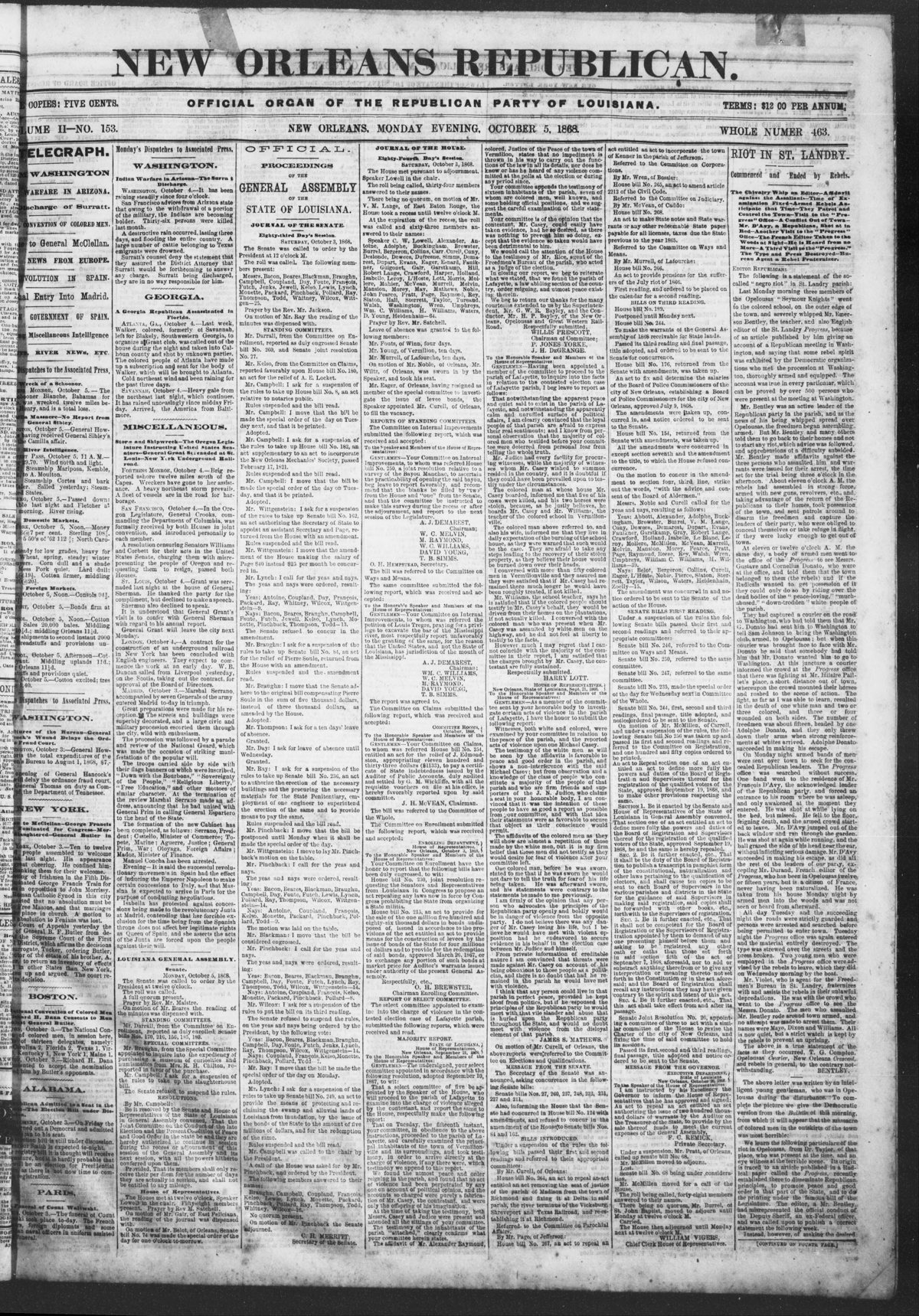

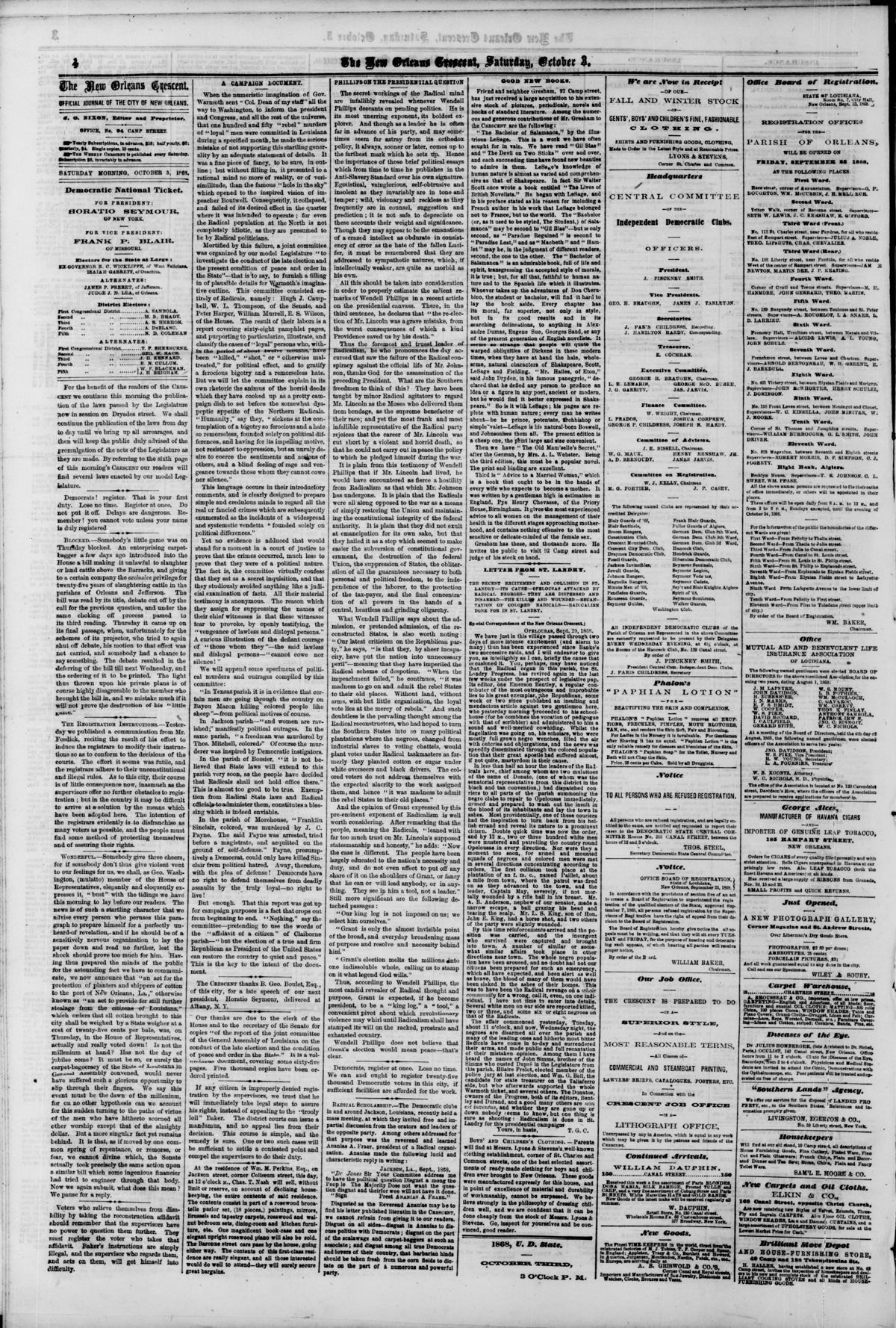
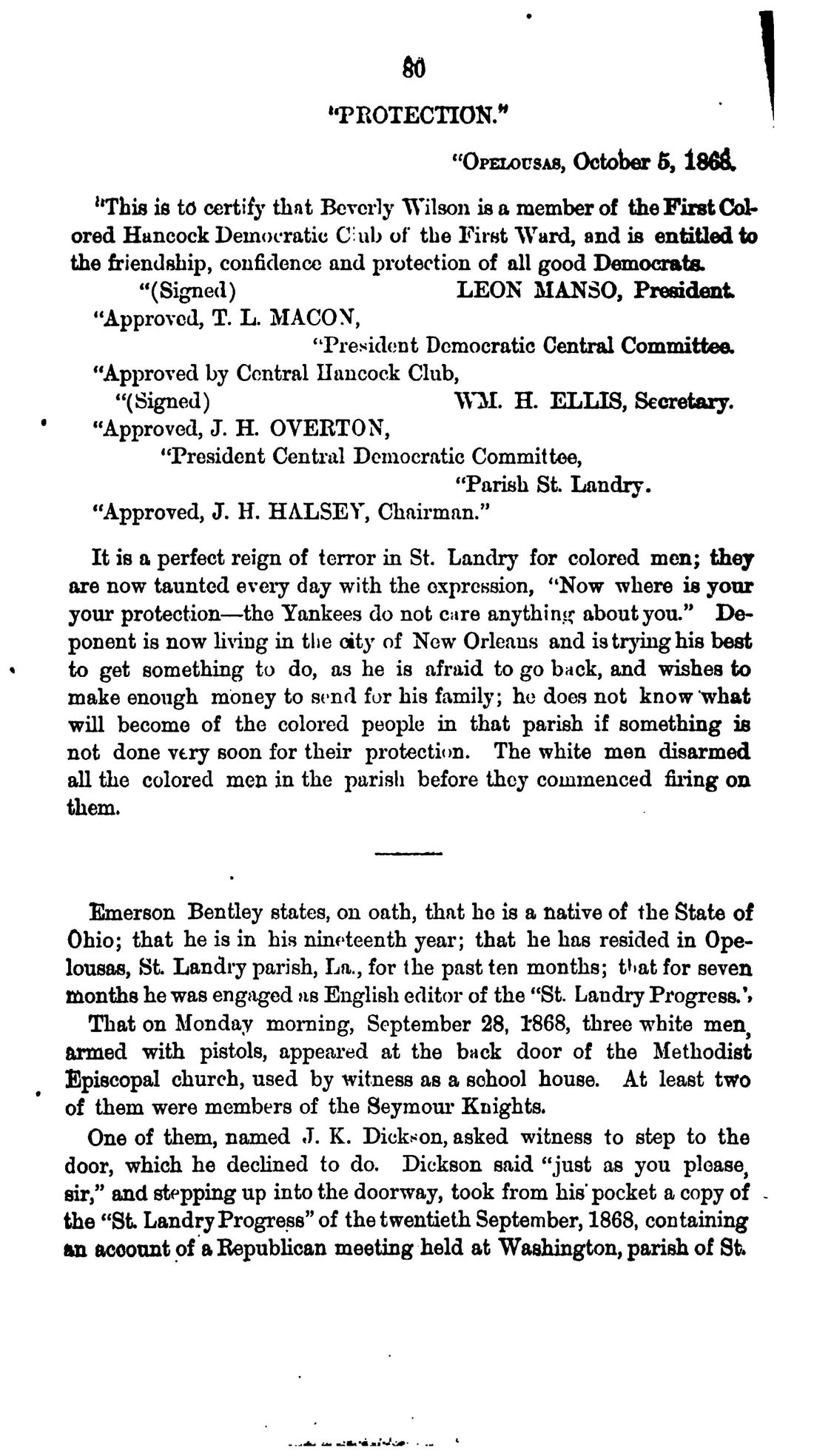
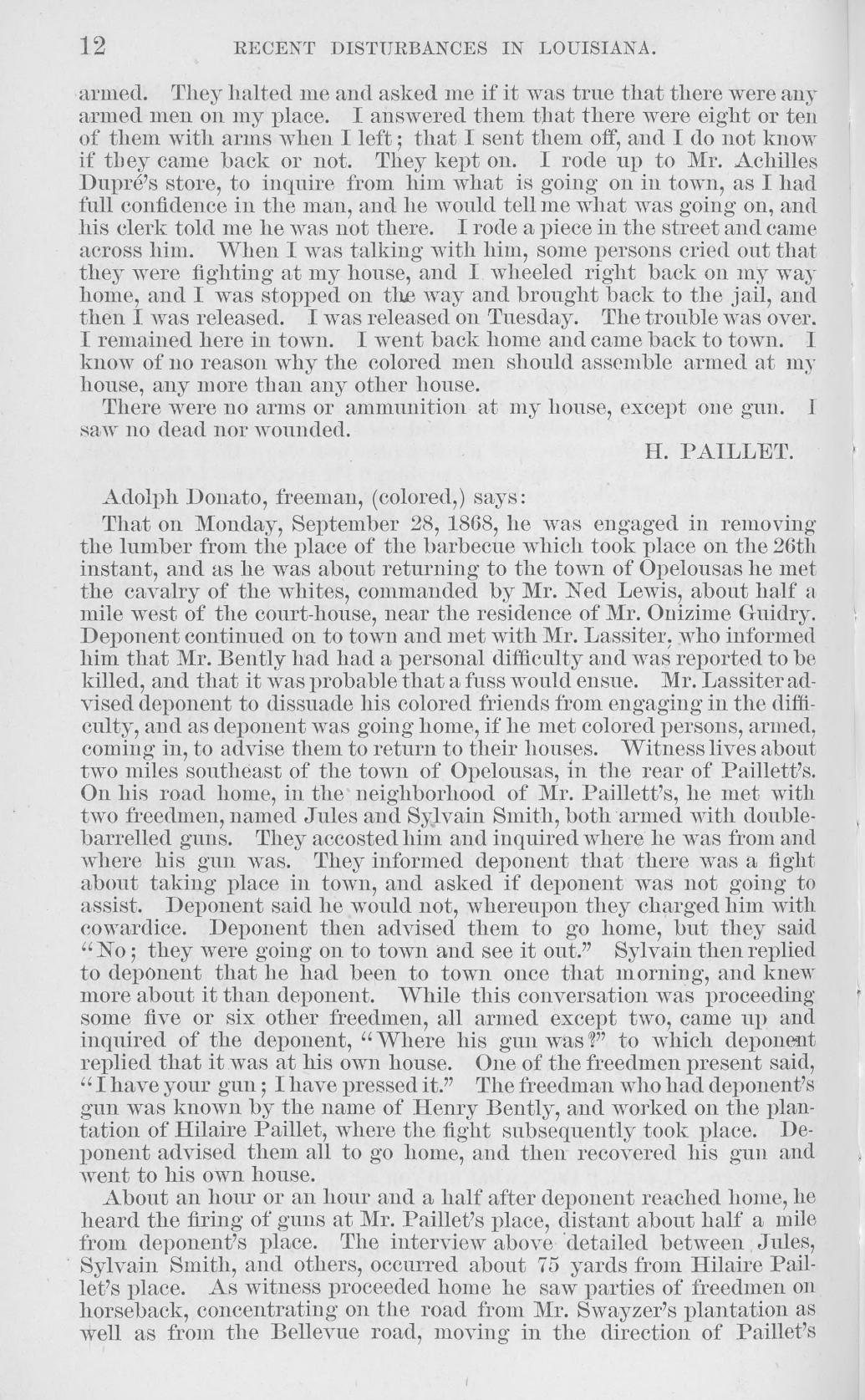
Sources and Archival Citations
• U.S. House of Representatives, Testimony Taken by the Sub-Committee of Elections in Louisiana, 41st Congress, 2nd Session, House Miscellaneous Document No. 154, Serial 1435 (Washington, D.C.: Government Printing Office, 1870), pp. 406–408 (sworn testimony of Emerson Bentley detailing the September 28, 1868 encounter with F. J. D'Avy, Gustave Donato, and Cornelius Donato).
• U.S. Congressional Serial Set, Vol. 1360, 40th Congress, 3rd Session, Report of the Secretary of War / Freedmen's Bureau Sworn Statements (1868–1869).
• Joint Committee of the General Assembly of Louisiana, Supplemental Report of the Joint Committee of the General Assembly of Louisiana on the Conduct of the Late Elections, and the Condition of Peace and Order in the State (New Orleans: A. L. Lee, State Printer, 1869), pp. 142–189 (St. Landry Parish eyewitness depositions).
• Bureau of Refugees, Freedmen, and Abandoned Lands (Freedmen's Bureau), Records of the Assistant Commissioner for the State of Louisiana, 1865–1869, Record Group 105, National Archives Microfilm Publication M1027, Roll 25 (Outrage Reports and October 1868 dispatches of Agent William H. Webster, St. Landry Parish, Louisiana).
• Gustave and Auguste Donato v. The Town of Opelousas, St. Landry Parish Civil Court Records, April 1870, St. Landry Parish Clerk of Court Archives, Opelousas, Louisiana.
• Father Donald J. Hébert, Southwest Louisiana Records: Church and Civil Records of Settlers, Vol. 8–9 (1866–1870) (Eunice, LA: Hébert Publications).
• Commemorating the 150th Year of the 1868 St. Landry Massacre, South Park Civic Center Descendant Recognition Records, Opelousas, Louisiana (2018).
Clayton Antwan Williams is a family historian, independent archival researcher, and citizen of the Atakapa-Ishak Nation specializing in primary-source documentation of Southwest Louisiana Creole and Indigenous family lineages.
Researched from the original records. Prepared with the help of AI — the documents, the citations, and the history are real.
The documented work is shared as it surfaces on Facebook.
© 2026 Clayton Antwan Williams. All rights reserved.