The Pope of St. Landry: The Donato Bello Dynasty
If you open a standard history textbook looking for the most powerful figures in nineteenth-century Louisiana, all you ever see is a list of white governors, plantation barons, and French aristocrats. What those books leave out completely is the documented history of a mixed Creole dynasty that built a real estate, agricultural, and lending empire so massive across St. Landry Parish that local people simply called its leader “The Pope.” For me, this is not just some forgotten piece of Louisiana history. It is a direct walk through my own family tree.
To understand how this empire was built, you have to look at an early Italian connection in Southwest Louisiana that almost never gets talked about. Back in the mid-eighteenth century, Donato Bello — an infantry officer and merchant born in Naples, Italy, around 1730 — settled at the Opelousas Post under a Spanish land grant. Through his union in New Orleans with Marie Jeanne Taillefer, a free woman of color, Donato Bello fathered three children: Martin, Marie Celeste, and my fifth great-grandmother, Catherine Victoire Donato Bello. Rather than getting pushed aside as French and Spanish colonial governments shifted, this family mastered colonial and American property law to lock down thousands of acres of prairie land.
First under Catherine Victoire’s brother, Martin Donato Bello, who died in 1848 leaving an estate of more than five thousand acres while operating as a private frontier lender across St. Landry Parish, and then at the height of the mid-nineteenth century under his son, Auguste Donato, born around 1797 and died December 2, 1874, the Donato dynasty stood as an economic powerhouse. While the post-Civil War system was doing everything it could to strip families of color of land and capital, Auguste Donato managed major plantation and real estate holdings in St. Landry Parish, fought and won district court cases to protect family wealth, and carried so much weight in Opelousas that the community nicknamed him “The Pope.”
Here is the exact paper trail showing how my bloodline connects straight to him. Both of our branches start from the exact same foundation: Donato Bello and Marie Jeanne Taillefer. On his branch, their son Martin Donato Bello, my fifth great-granduncle, and Julie Prados were the parents of Auguste Donato, making “The Pope” my first cousin five times removed. On my direct line, their daughter Catherine Victoire Donato Bello, my fifth great-grandmother, married Jean Baptiste Guillory at St. Landry Catholic Church in Opelousas on November 3, 1789, right after signing a formal civil marriage contract. From Catherine Victoire and Jean Baptiste Guillory, our bloodline runs through the Guillory and Papillion families of St. Landry Parish down to my great-grandmother Edna Papillion, to my grandmother Lena LeDay, and straight to me.
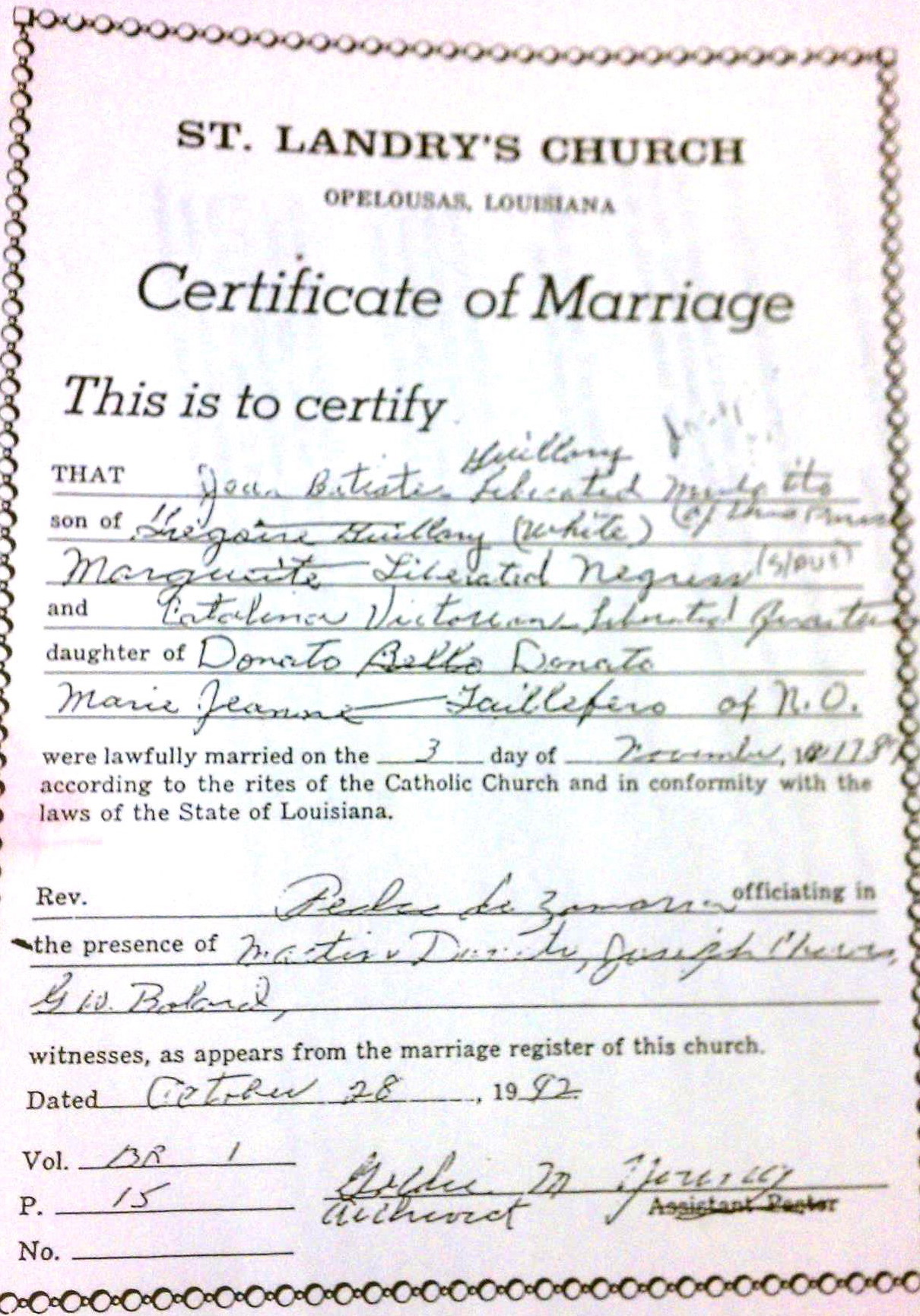
Mainstream history books want you to believe that our people spent the 1800s broke, powerless, and hidden in the background. The St. Landry Parish courthouse records prove the exact opposite. The Donato dynasty stands as documented proof that our Creole, Italian, African, and Atakapa-Ishak ancestors were sharp strategists, major landowners, and power brokers who forced the legal system to respect their names.
Sources
St. Landry Parish Clerk of Court, Opelousas — Succession No. 1339, Martin Donato Bello (filed January 7, 1848); Succession No. 3766, Auguste Donato (December 10, 1874); District Court Case No. 5962 (filed September 27, 1852).
St. Landry Catholic Church, Opelousas — marriage of Catherine Victoire Donato Bello and Jean Baptiste Guillory, November 3, 1789.
Donald J. Hébert, Southwest Louisiana Records.
Carl A. Brasseaux, Keith P. Fontenot, and Claude F. Oubre, Creoles of Color in the Bayou Country (1994).
Loren Schweninger, Black Property Owners in the South, 1790–1915 (1990).
U.S. Bureau of Land Management, General Land Office records; U.S. federal censuses. WikiTree profiles Bello-43, Bello-51, and Donato-36.
Researched from the original records. Prepared with the help of AI — the documents, the citations, and the history are real.
The documented work is shared as it surfaces on Facebook.
© 2026 Clayton Antwan Williams. All rights reserved.