The Ancestry of Clayton Antwan Williams
THE ANCESTRY OF CLAYTON ANTWAN WILLIAMS
A Source-Cited Proof Document and Historical Archive
As researchers and family historians, we understand that our work is only as strong as the evidence we leave behind. When we share our citations openly, we build a bridge that helps the entire community uncover the truth of our shared history. I am publishing this documented lineage and proof argument not just as a personal memoir, but as an open archive for any family researcher, cousin, or historian tracing these same paths — through the Southwest Louisiana Creole heartland, and through our deep connection to the Attakapa-Ishak Nation.
To be a Louisiana Creole is to inherit a beautiful, heavy, and sacred storm. Our identity was not born in comfort; it was forged in the fire of survival, woven from the unyielding spirit of First Nations women, the bold grit of early pioneers, and the sacred, unbreakable strength of Afro-Creole matriarchs. My name is Clayton Antwan Williams. Running through my veins is a continuous, living river of history, and the keeper of that river was my grandmother, Lena LeDay Williams. Lena was the matriarch, the pillar of our family, and the bridge to everything we are.
HOW TO READ THIS DOCUMENT: Every claim carries its weight openly. DOCUMENTED means the record exists and its citation is given. VERIFIED means the entry was read firsthand from the database or publication itself. TREE means the link stands in my family tree, consistent with the records around it, not yet carried by its own document. GAP means the seam is open and the record that closes it is named. Nothing in this document is upgraded beyond its paper. A proof that names its own gaps cannot be ambushed.
THE ROOT
My line is documented at its base. The 1940 United States Census, Acadia Parish, Ward 7 (ED 1-30, Sheet 6A), shows my grandmother Lena LeDay as a child in the household of her parents, Alsay LeDay Sr. (1896–1988) and his wife Edna, with ten of her siblings (the family is indexed under "Alsay Ladet"). From that household, seven lines run back into the colonial record.
I. THE LEDÉ LINE
Jean François Ledé (born 1718, Lille, Flanders) — Louis Ledé (c. 1747–1834) — Onesime Lede Sr. (b. 1799) — Celestin Lédé (b. 1839) — Louis Evêque Lede (1869–1964) — Alsay LeDay Sr. — Lena — my father, Clayton Paul Williams (1956–2022) — me.
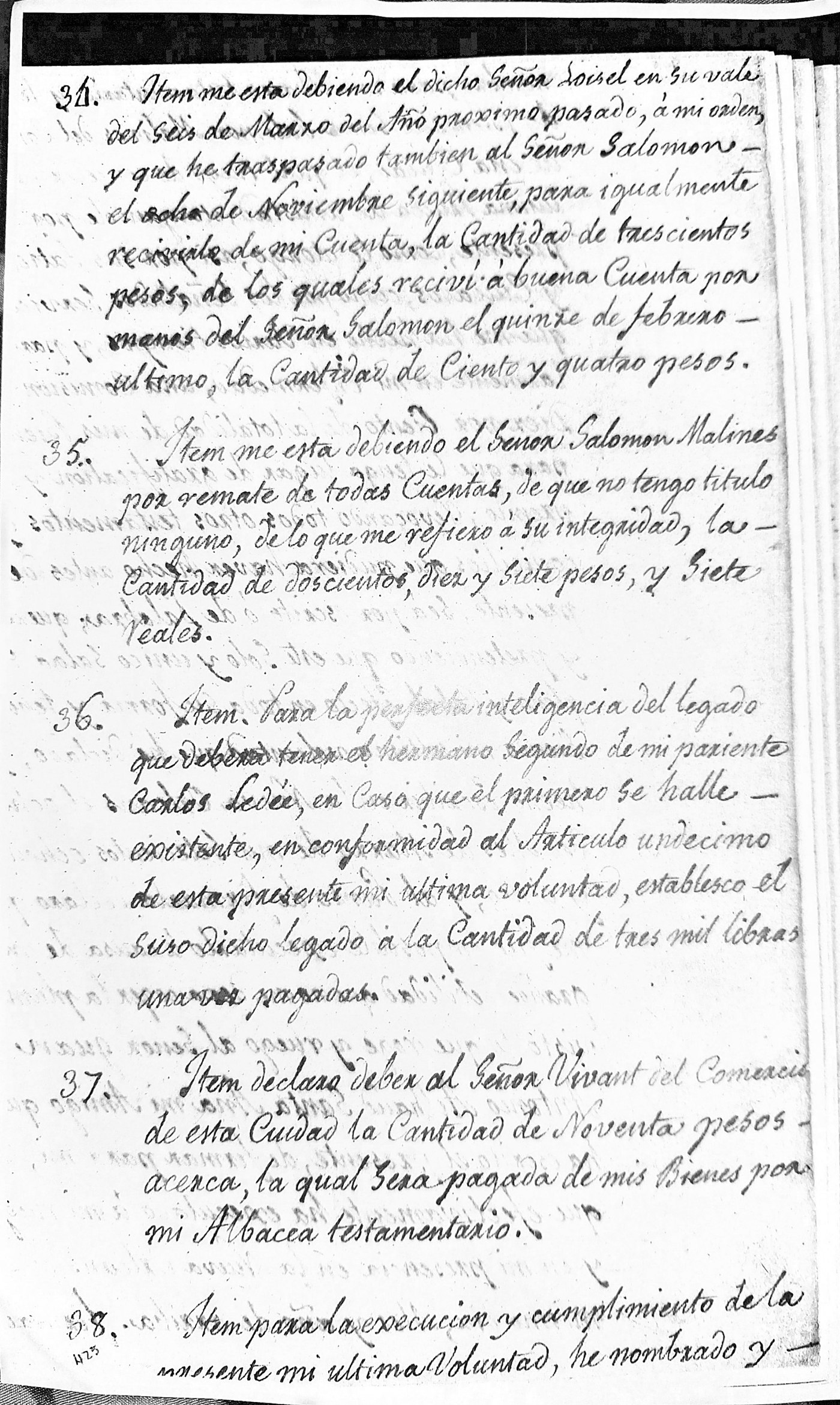
- The will [DOCUMENTED]: the last will of Jean François Ledée, 11 March 1785 (St. Martin Parish Courthouse, Original Acts vol. 4½, #67; also New Orleans Notarial Archives, Rodríguez Book 4, fols. 216–22v). Item 22 frees "my mulatto named Louis" after his death. Item 23 gives Louis 2,000 pesos, charged with buying and freeing his five children by Thérèse: Louison, Françoise, Thérèse, Jean-François, and Marinette. Item 24 directs Louis to buy Françoise, his mother. His land: purchased 8 March 1762, "between the Teche and Vermilion bayous"; Spanish grant, 19 February 1769.
- The son [DOCUMENTED]: the 1777 census of the Attakapas post (compilation of the Spanish colonial census) heads Jean François's household "his natural son, Louis LÉDÉE." Louis's baptism stands in the register (St. Martin Church vol. 1, p. 16, 8 January 1766).
- The freedom [VERIFIED]: Gwendolyn Midlo Hall's Afro-Louisiana Free Database, read directly from the database file itself — record dated 6 April 1785, St. Martin, master "Jean Francois LeDee," the freed man "Louis," and the means of freedom coded FREED UNDER WILL. The will was signed 11 March; this act follows within four weeks.
- The charge carried out [DOCUMENTED · VERIFIED]: on 24 December 1794, Louis Lede freed six people in one act (Original Acts of St. Martin, Book 15, #437): Françoise (30), Louison (20), Françoise (17), Thérèse (16), Jean-François (13), and Mariette (9). The five young people are the five children of Item 23, in the will's order, their ages matching the will's ages carried forward nine years. Stated openly: the will names the children's mother as Thérèse; the 1794 act frees a Françoise, age 30, at the head of the group. Which woman she is — the children's mother, or Louis's own mother of Item 24 — the original act will decide.
- The joining marriage [DOCUMENTED]: Onesime Lede Sr. married Marie Louise Guillory on 31 July 1824, St. Landry Parish.
- [GAP — declared]: the generation between Louis Ledé and Onesime, the link through Paul Ledee, stands on my tree only. The record that closes it is named: Louis Ledé's succession, St. Martin Parish No. 759 (1834). The generations from Celestin to Alsay likewise stand TREE, to be carried generation by generation.
II. THE GUILLORY LINE
Jean Baptiste Guillory Sr. (b. 1766), married to Catherine Victoire Donato Bello (1770–1823) — Louis Casimir Guillory Sr. (1807–1880) — Marceline Guillory (1849–1875) — Marceline Allain (1871–1912) — Edna — Lena.
- The freedom fight [MY MEMOIR — my account, as I corrected it and stand on it]: Marguerite Guillory and her children fought the Guillory heirs in the Spanish colonial courts — the Guillory v. Fontenot battle. The court did not free them by decree. The fight ended in a compulsory financial settlement on 5 April 1783, under which Marguerite and her children secured their legal freedom by paying 600 pesos to the white Guillory heirs. This stands on my family's record and my word, and is labeled as such.
- A separate woman, a separate fight [DOCUMENTED · VERIFIED]: the emancipation petition of 31 December 1770 (New Orleans Notarial Acts, Almonaster y Roxas #203) — Margarita, held by Gregorio Guillory, and her two children, read firsthand in Hall's Free Database: the means of freedom coded LITIGATION, and Hall's note on the record points to the court case reported at Louisiana Historical Quarterly XV, p. 545 — freedom granted in 1782. Two women, two court fights, one surname; the records are kept distinct, as the paper keeps them.
- The links [DOCUMENTED]: Jean-Baptiste Guillory's freedom, 1782 (LHQ 15, p. 545). Joseph Guillory documented in 1792 on the census of free people of color (Archivo General de Indias, legajo 206), married 19 April 1803 (St. Landry mariages vol. 1, p. 164), his bride recorded "mulâtresse libre" — a free woman of color. [GAP — declared]: whether the documented Joseph is one man or two is decided by his succession, St. Landry No. 1840 (1854), not yet opened.
III. THE DONATO BELLO LINE
The Donato Bello family of St. Landry Parish, from Naples [DOCUMENTED as a family]: Maximilien Donato Bello (1732–1787); his son Martin Donato Bello, free man of color, whose 1847 will and succession administered an estate of 5,906 acres (National Park Service, Martin Donato House nomination, 2004); Céleste Susanne Donato married Baptiste Meuillon, 18 February 1796 (Louisiana State Archives, marriage contracts of the Opelousas Post, no. 178), and Baptiste's own emancipation stands in 1777 (Garic vol. 8, no. 67). Catherine Victoire Donato Bello (1770–1823), Martin's sister, married Jean Baptiste Guillory Sr. — the marriage that braids this line into the Guillory line. Her placement stands on my tree and my memoir; the Donato segment is detached in the shared tree and is being re-proven, stated plainly. Generations in Italy beyond Maximilien are family tradition [TREE], and are not claimed as documented here.
IV. THE PAPILLON LINE
Michel Papillon (c. 1744–1750) — Alexandre Papillon (1803–1858) — Felonise Papillion (1827–1920) — Marie Felonise Guillory (1848–1919) — Edgard Savinien Papillon (b. 1873) — Edna Papillion (1902–1985) — Lena.
- He bought himself [DOCUMENTED · VERIFIED]: Michel's manumission, 1 January 1799, Document No. 9, Louisiana State Archives — "Liberté de Miguel Papillon, Mulatre," the seller Don Manuel Antonio de Soto Bermúdez. Read firsthand in Hall's Free Database, the means of his freedom is coded SELF-PURCHASE: his own money bought his name back. The full record set is reproduced in Winston De Ville, Papillon: The Freedom of a Slave in Colonial Louisiana (2004). A firsthand search of Hall's Slave Database — all 100,666 records — confirms Michel does not appear among the enslaved; his record stands on the Free side. No price appears in the record; accounts of one are family telling, labeled as such.
- The marriages [DOCUMENTED]: Marie Joffrion, 7 January 1797, Avoyelles. Eulalie Simon, 19 November 1799, Opelousas Church, Register of Black Marriages vol. 1, p. 95.
- The judgment [DOCUMENTED]: Michel and Eulalie sued Charles Simon in the Fifth Judicial District Court at Opelousas over her loan of $716.14, secured by Grand Prairie land (Petition No. 20882406, filed 18 March 1824). Judgment for Michel and Eulalie, 21 May 1824; the land was seized and sold. A census page in my own keeping names "Michel Papillion" as head of his own household, among Simon, Guillory, and Fontenot families.
- The braid [DOCUMENTED]: Alexandre Papillon married Colombe Guillory, 15 February 1847 (Opelousas Church v. A, #141) — Papillon into Guillory, Guillory into Papillon, all the way down to my grandmother.
V. THE HARDY AND NEZAT LINE
Thomas Hardy (b. 1765), married to Marie Solange Latiolais (1776) — Louis Hardy (b. 1795) — Antoine Hardy (1838–1907) — Azama Marie Hardy (1874–1952) — Alsay. The Hardy generations stand TREE. The Nezat root behind them is DOCUMENTED in the district itself: Pierre Nezat heads a household of 14 individuals, 130 animals, on 52 arpents in the 1781 census of the Attakapas (page images on file). And the register ties my Nezat line to an Atakapa child directly: Cyprien Tinlau, baptized 9 January 1820 and recorded "sauvage Atakapas" (St. Martin Church v. 7, #777), was sponsored at his baptism by Josephine Nezat.
VI. THE DOMINGUEZ LINE — ISLEÑO
Manuel Dominguez (b. 1717, Realejo, Tenerife) — Antonio Vicente Dominguez (b. c. 1759) — Pierre Joseph Dominguez (1803–1864) — [gap] — Josephine Domingue, who married Alexander Williams on 13 May 1882.
- The crossing [DOCUMENTED]: the frigate San Ignacio de Loyola embarked at Santa Cruz de Tenerife on 29 October 1778 and arrived at New Orleans on 9 January 1779. The published passenger list (Villeré, The Canary Islands Migration to Louisiana, 1778–1783, p. 22; Din, The Canary Islanders of Louisiana) reads: "Manuel DOMINGUEZ; Juana Francisca; Antonio, son, age 19; Agustin, son, age 18; María Luisa, daughter, age 12; Josef, son, age 5." Antonio Vicente was the 19-year-old son. Manuel's father, in his 1759 Realejo marriage record, is named plainly as Juan Dominguez; generations beyond him are family tree [TREE], not documentation.
- Pierre Joseph [DOCUMENTED]: born 10 June 1803, Plattenville; died, buried 5 May 1864. Son of Antonio Vicente and Maria Franquez (Bernard, The Origin of the Domingue Family in Louisiana, 2004, p. 53). He married Marie Josephine Bernard Hernandez on 27 August 1827 at Donaldsonville, Ascension Parish (Sons of the American Revolution lineage applications ACN 37422 and ACN 5502).
- [GAP — declared]: no published source names a son "Pierre Domingues (1833–1861)," and no published source names Josephine Domingue's parents. Her descent from Pierre Joseph is an open gap. The record that settles it is her 1882 church marriage entry at St. Peter, Carencro (abstracted in Hébert, Southwest Louisiana Records, vol. 15).
VII. THE WILLIAMS LINE
The documented Williams line begins with Alexander Williams himself. His marriage to Josephine Domingue, 13 May 1882, is on record (FamilySearch ark:/61903/1:1:QLMH-VZV7); he heads his household at Carencro in 1900, stands in the 1910 census, and his succession is No. 9088, 15th Judicial District Court, Lafayette. The 1920 census (Lafayette, ED 39, Sheet 14-B) shows Josephine heading the household with her son Clayton Paul Williams (1932–1970), my grandfather — father of Clayton Paul Williams (1956–2022), my father. Alexander's parentage is NOT VERIFIED: no record on file names his parents, and no lineage behind him is claimed in this document. And my family's two namings of Lena's mother are carried unmerged: my ruling and my family's word name her Edna Guillory, wife of Alsay; my tree also carries an Edna Papillion (1902–1985). Both stand recorded; the 1931 Liberty County, Texas record is the pull that settles it.
VIII. NATIVE DESIGNATION IN THE RECORD
Beyond descent, the records designate people in my own family surnames as Native, in the government's own hand:
- Eloise of Opelousas: baptized 2 April 1809, age 7, Opelousas Church vol. 1-B, p. 464 — the register calls her "indienne de nation Opelousas," an Indian of the Opelousas nation; in the margin, "sauvagesse Opeloussan." The abstract names no parents. I identify Eloise as my 4th great-grandmother; that identification is my attestation, recorded as mine, and the original register page is the named pull.
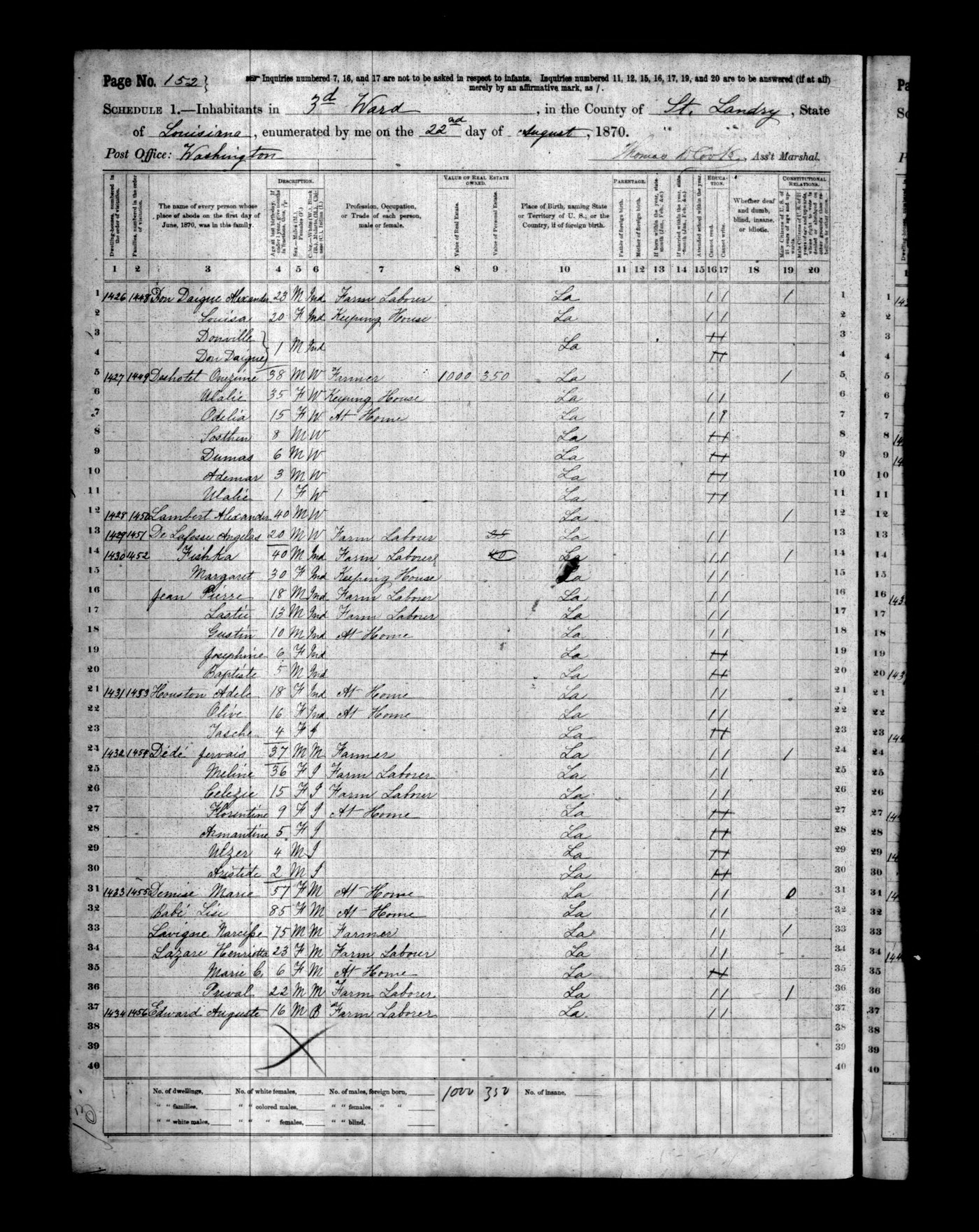
- 1870 Census, St. Landry Parish, Ward 3, p. 152 (page image on file): the household of Gervais — his wife Melanie and their five children, every one marked "I" (Indian). The surname on the page has been read both "Ledé" and "Dede"; person-level descent is unproven and is not claimed.
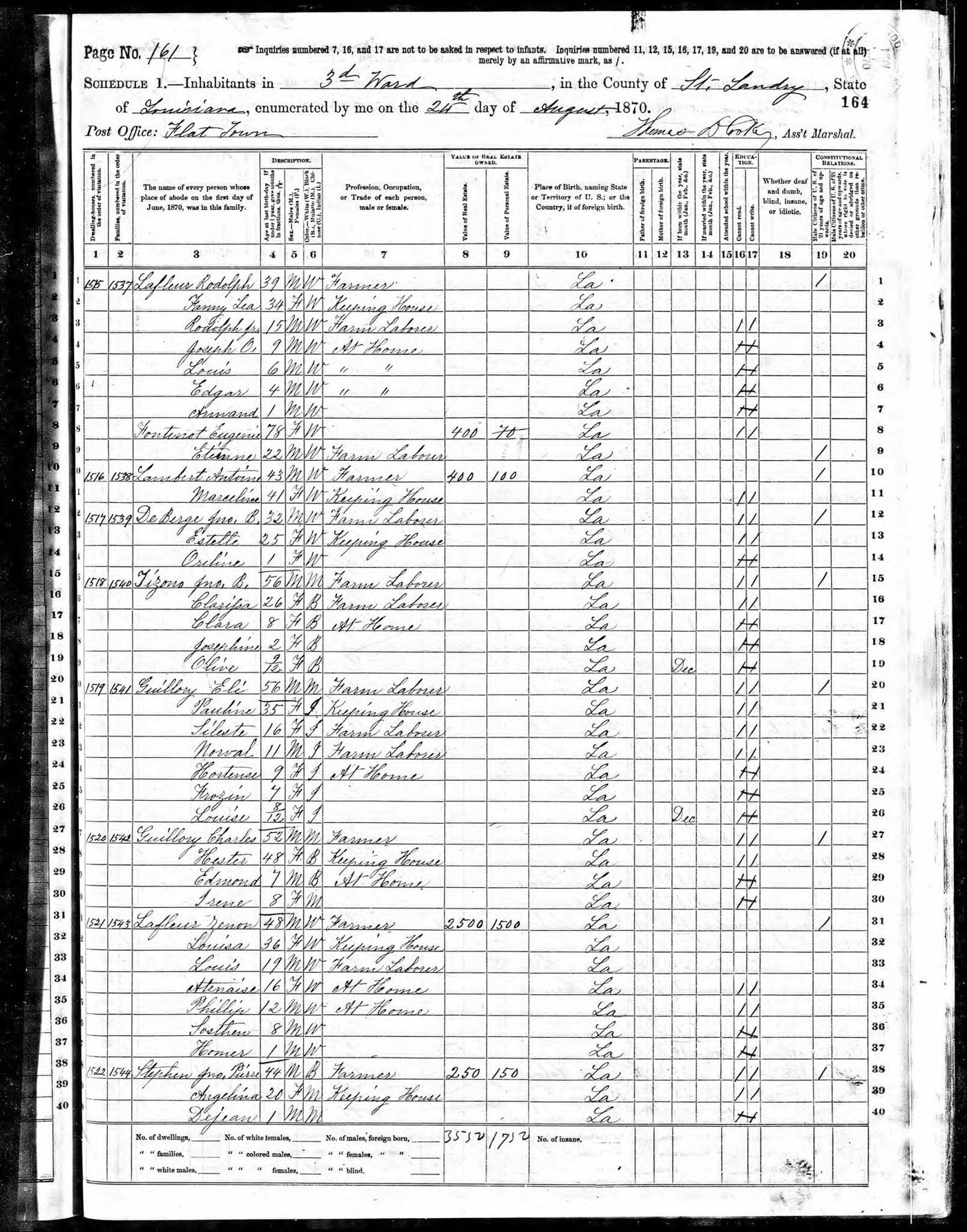
- 1870 Census, St. Landry Parish, stamped p. 164 (page image on file; published in Le Comité, Native Americans on the 1870 Louisiana Census, p. 164): the household of Eli Guillory — his wife Pauline and their five children, every one marked "I" (Indian). Person-level descent unproven; not claimed.
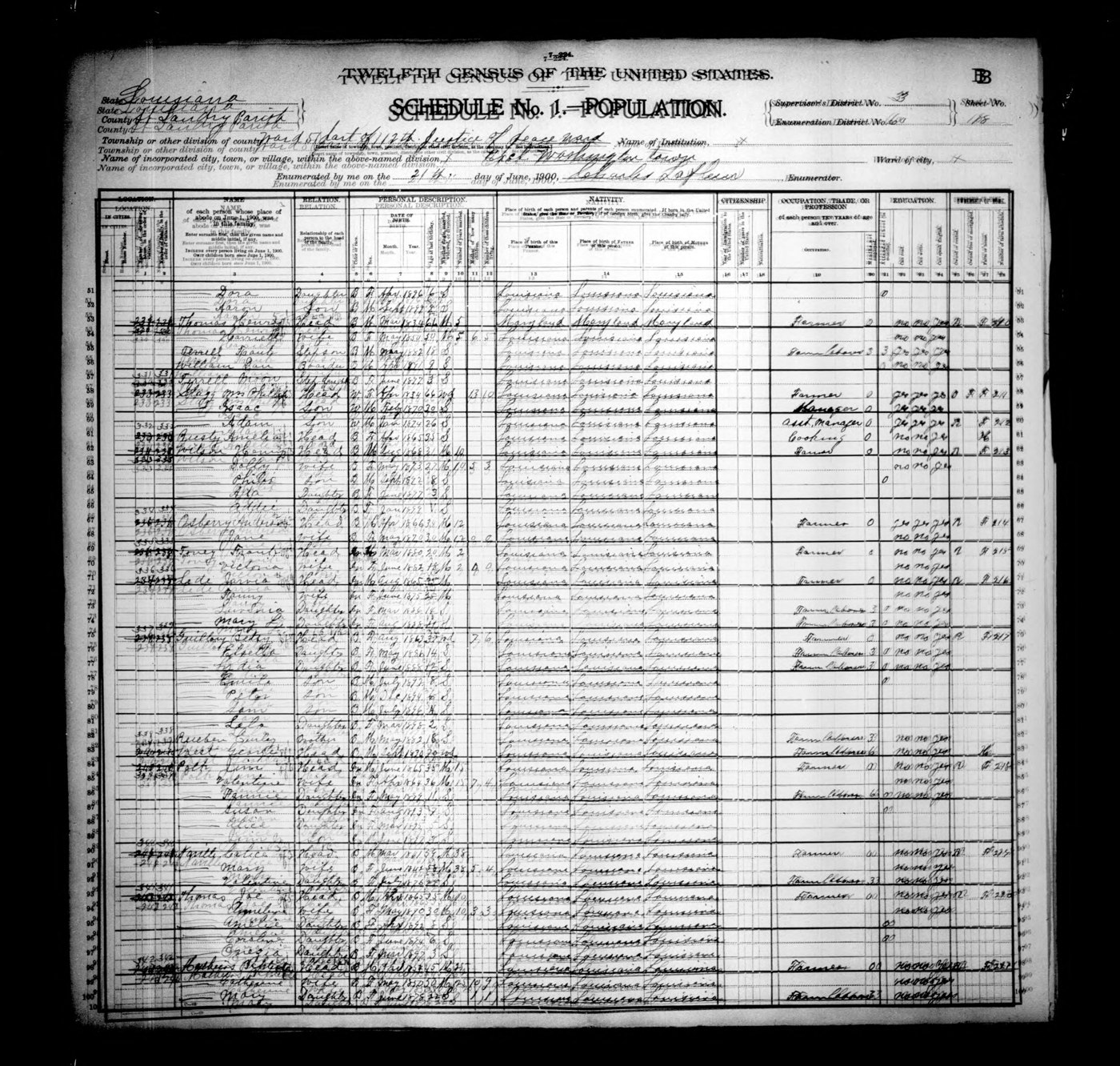
- 1900 Census, St. Landry Parish, ED 60, Sheet 18B (page image on file): Jarvis Lede, his wife Fanny, and daughters Luvinia and Mary L. — all four marked "In" (Indian). On the same and neighboring sheets, whole households stand marked Indian beside Lede and Papillon households marked otherwise: the reclassification of a people, visible in a single frame.
IX. THE ATAKAPA-ISHAK NATION RECORD
My tribe's existence does not rest on my family's papers. It rests on the record of three governments and the Smithsonian Institution:
- Chief Kinemo (Kanimo), chief of the Atakapa village called Lamonier, sold two leagues between the Vermilion and the Teche in November 1760 (St. Martin Parish, Copies of Original Acts, vol. 1; ratified by Governor d'Abbadie's grant of 1764).
- Celestin La Tortue, "Chief of the Attakapas Indians" — 26 land sales, 1784–1804, certified 15 November 1820 at the Opelousas Court House.
- January 1885, Lake Charles: Albert Gatschet's linguistic fieldwork — his principal Atakapa informants were Louison Huntington and Delilah Moss (Bureau of American Ethnology, Bulletin 108, 1932, pp. 4–5).
- 1907 and 1908: John R. Swanton of the Bureau of American Ethnology "visited them and found that there are still nine who remember something of the language" (Bulletin 43, 1911, p. 362). The nine: Teet Verdine, Eliza Verdine, Armojean Reon — photographed by the Smithsonian, Plates 19b and 32b — Mrs. Delia Morse, Delphine Williams, Ellen Sclovon, Eugene Reon, Mary Jones née Cameron, and Felix Wartell. Swanton's field notebook (National Anthropological Archives, MS 4201) records the people's own preference: "called Red Bones nowadays but do not like the term, preferring Tuckapaw or Attacapa."
- The Nation's Letter of Intent to petition for federal acknowledgment has stood on file with the Office of Federal Acknowledgment since 2 February 2007, Petitioner No. 309. The Nation endures today under Chief Shawn Papillion.
- The Nation's enrollment rests on a documented ancestor network: a Master Index of 209 historical surnames, and a roster of about 210 documented ancestors, 54 of them designated Native in the record itself. Of the nine relationship paths from my own research that I supplied to the tribal archives, five are documented from my tribe by the Smithsonian Museum — my statement, recorded as mine. The surnames those paths reach — Reon, Verdine, Moss — are the surnames of the documented speakers above. A shared surname is a doorway, not proof of descent, and I claim no more for it than that.
X. THE OPEN SEAMS, DECLARED
1. Louis Ledé to Paul Ledee — TREE. Closing record: Louis's succession, St. Martin No. 759 (1834).
2. Eloise's parentage — the 1809 register page names no parents; my identification of her is my attestation.
3. Josephine Domingue's parentage — the 1882 St. Peter (Carencro) church entry settles it.
4. Which Joseph Guillory — decided by his succession, St. Landry No. 1840 (1854), unopened.
5. Edna Guillory / Edna Papillion — both namings recorded, unmerged; the 1931 Liberty County record is the pull.
6. Catherine Victoire Donato Bello's placement — tree and memoir; the Donato family itself is documented.
7. Checked and NOT carried: a claimed Mi'kmaq descent through Catherine LeJeune of Acadia. Published evidence runs against it — White's Dictionnaire lists her parents as unknown, and the mtDNA of more than fifty of her matrilineal descendants is haplogroup U6a7a1a, European, not Native (Estes, DNAeXplained, 2025). It is not asserted here. Our Algonquin root, Marie Miteouamigoukoue, is documented in her own 1657 marriage act at Trois-Rivières as "Algonquin by nation"; my descent from her stands TREE.
8. The two originals still to pull in person: Michel Papillon's freedom act (FamilySearch DGS 7689875) and Jean François's manumission act for Louis (St. Martin Original Acts vol. 4, #92). Nothing above rests on wording that has not been read.
MASTER CITATION INDEX
St. Martin Parish Courthouse, Original Acts vol. 4½ #67 (will of Jean François Ledée, 1785); Book 15 #437 (Louis Ledé manumission act, 1794); Copies of Original Acts vol. 1 (Kinemo deed, 1760). New Orleans Notarial Archives: Rodríguez Book 4 (1785); Almonaster y Roxas #203 (1770). Louisiana State Archives: Doc. No. 9 (Papillon manumission, 1799); Opelousas marriage contracts no. 178 (1796). Gwendolyn Midlo Hall, Afro-Louisiana History and Genealogy — Free Database and Slave Database files, read firsthand 5 November 2026. Church registers: St. Martin Church vol. 1 p. 16; vol. 7 #777; Opelousas Church vol. 1-B p. 464; Register of Black Marriages vol. 1 p. 95; Opelousas Church v. A #141; St. Landry mariages vol. 1 pp. 43, 164. Fifth Judicial District Court, St. Landry, Petition No. 20882406 / Doc. No. 845 (1824). U.S. Census: 1870 St. Landry pp. 152, 164; 1900 St. Landry ED 60 Sheet 18B; 1900 Carencro; 1920 Lafayette ED 39 Sheet 14-B; 1940 Acadia ED 1-30 Sheet 6A. Attakapas census 1777 (compilation); Attakapas census 1781; AGI legajo 206 (1792). De Ville, Papillon (2004). Villeré, The Canary Islands Migration to Louisiana, 1778–1783. Din, The Canary Islanders of Louisiana. Bernard, The Origin of the Domingue Family in Louisiana (2004). SAR lineages ACN 37422, ACN 5502. Hébert, Southwest Louisiana Records. Le Comité, Native Americans on the 1870 Louisiana Census. Swanton, BAE Bulletin 43 (1911) and Bulletin 68; Gatschet & Swanton, BAE Bulletin 108 (1932); Smithsonian NAA MSS 4201, 2424, 239, 1576. NPS, Martin Donato House nomination (2004). U.S. Office of Federal Acknowledgment, Petitioner No. 309 (Letter of Intent, 2 February 2007).
True Creole culture is the living definition of resilience — a rich blend where French, Spanish, Italian, African, and First Nations cultures collided, adapted, and forged something entirely new. If you look at who I am, I am built exactly like a classic Louisiana gumbo. My lineage is a rich roux, simmered over centuries, beautifully mixed with various cultures, flavors, and histories.
I am the proud grandson of Lena LeDay Williams. I am Clayton Antwan Williams, and I am a Creole man.
— Clayton Antwan Williams, Family Historian · Citizen, Atakapa-Ishak Nation · 5 November 2026
First shared on Facebook, November 5, 2026.
The Documents
Researched from the original records. Prepared with the help of AI — the documents, the citations, and the history are real.
The documented work is shared as it surfaces on Facebook.
© 2026 Clayton Antwan Williams. All rights reserved.