The Ancestral Legacy of Clayton Antwan Williams
⚜️ THE ANCESTRAL LEGACY OF CLAYTON ANTWAN WILLIAMS ⚜️
To my fellow Creole family, researchers, and cousins: I am sharing my personal memoir and documented lineage tracing through my beloved grandmother, Lena LeDay Williams.
Our roots run deep into the dirt of St. Landry Parish, Carencro, Opelousas, and Basile. This history honors our ancestors who shaped Louisiana and the Texas frontier—including the LeDay (Ledet) line, the freedom fights of Marguerite & Joseph Gregoire Guillory, the economic empire of Martin Donato Bello, the Isleño roots of Antonio Vicente Dominguez, and our ancient Algonquin & Mi'Kmaq root mothers.
I am proud to share our living history. Please read through, and let me know if you recognize these names or if our lines cross!
👑 THE ANCESTRAL LEGACY OF CLAYTON ANTWAN WILLIAMS 👑
~ My Memoir: The Living Story of My Heritage, Carried Through LENA LEDAY WILLIAMS ~
To be a Louisiana CREOLE is to inherit a beautiful, heavy, and sacred storm. Our identity was not born in comfort; it was forged in the fire of survival, woven from the unyielding spirit of FIRST NATIONS women, the bold grit of early pioneers, and the sacred, unbreakable strength of AFRO-CREOLE matriarchs. My name is CLAYTON ANTWAN WILLIAMS. Running through my veins is a continuous, living river of history, and the keeper of that river was my grandmother, LENA LEDAY WILLIAMS.
LENA was the absolute matriarch, the pillar of our family, and the bridge to everything we are. She was the one who carried the ghosts of our ancestors in her eyes, passed their resilience into our bones, and held the sacred threads of our identity together so they would never be lost to time.
📍 THE HISTORIC FOREFATHERS OF THE CREOLE HEARTLAND 📍
My grandmother’s story, and the stories of the grandmothers before her, are permanently written into the dirt of ST. LANDRY PARISH. Her people did not merely inhabit communities like OPELOUSAS, CARENCRO, BASILE, and ST. CLAIR—they spoke them into existence. Our ancestors cleared the wild frontiers, laid the very cornerstones of the towns standing today, and breathed life into the CREOLE heartland as the absolute founders, architects, and forefathers of those historic cities. For any onlookers and researchers wanting to trace this map themselves, the exact, documented lines run directly through these historical figures:
⚜️ THE FOREFATHER OF CARENCRO: Long before it was incorporated, the settlement of CARENCRO was forged by our maternal ancestral family. The pioneer PIERRE CORMIER cleared that wild frontier, laid the initial foundations, and stood as a defining forefather of the city where our roots were planted.
⚜️ THE FOUNDING OF BASILE: The town of BASILE stands as a permanent monument to our family's footprint. The city was founded and named in honor of our ancestral relative, BASILE FONTENOT, a trailblazing pioneer of the legendary FONTENOT clan who first settled and tamed the land.
📜 THE GENEALOGY OF GREAT HISTORICAL HISTORY 📜
While some branches of a family tree are made of simple dates, our lineage is forged directly into major turning points of North American history. The deeper I look, the more I realize our family didn't just witness history—we engineered it:
⚔️ THE TEXAS FRONTIER AND THE PRESIDIO DE BÉXAR: Deep within my maternal tapestry lies a monumental connection to the earliest foundations of Texas history, running directly through my 5th great-grandmother, BRIGITTE CATHERINE PEREZ PETZ PAIRE ALVARADO (1802–1900). She was the daughter of JOSÉ ANTONIO ALVARADO (1782–1879) and MARIA VICENTA PORRAS, tracing straight back to my 8th great-grandparents, SALVADOR BELTRÁN and THERESA DE PORRAS. In the early 1700s, the Spanish Crown was desperately trying to secure the wild Texas frontier from rival empires and established the Presidio San Antonio de Béxar. My ancestors were part of that elite, hardened force of original frontier soldier-colonists. When King Philip V ordered the legendary 16 Canary Island civil families to cross the ocean and build the civil government of San Antonio in 1731, it was my family—the established military presidio force—who stood guard, welcomed them, protected them from absolute destruction on the frontier, and ultimately intermarried with them to secure Texas. Decades later, moving eastward along El Camino Real de los Tejas under Spanish colonial rule, this proud, pioneering military line traveled across the border straight into the heart of St. Landry Parish.
⚖️ THE PAPILLION LINE AND THE COLONIAL FIGHT FOR FREEDOM: Through my great-grandmother Edna Papillion (1902–1985), our family stands at the center of one of the most significant legal disputes over status in colonial Louisiana history. The line moves directly through her father Edgard Savinien Papillon (b. 1873), Marie Felonise Guillory (1848–1919), Felonise Papillion (1827–1920), Alexandre Pierre Papillion (1803–1858), and Michel Papillon (1780–1825), anchoring with my 7th great-grandfather, Jacques Francois Papillion Dit Lebranche (1698–1752). This lineage intersects directly with Marguerite, an enslaved woman of color, and French pioneer Joseph Gregoire Guillory I (1712–1777). In the late 1700s, Marguerite and her children engaged in intense colonial court battles (Guillory v. Fontenot) regarding their status. While the Spanish colonial court did not grant them a victory by decree, the legal battle resulted in a compulsory financial settlement on April 5, 1783. Under this ruling, Marguerite and her children secured their absolute legal freedom by paying 600 pesos to the white Guillory heirs, establishing the Afro-Creole foundation carried down to our family today.
💼 THE LEGENDARY ECONOMIC EMPIRE OF THE BELLO LINE: Woven deep into our bedrock is the elite BELLO bloodline. My 5th great-grandmother, CATHERINE VICTOIRE DONATO BELLO (1776–1823)—daughter of Maximilien Donato Bello (1732–1787) and granddaughter of Victor Donato Bello (1698–1758)—traces back to my 10th great-grandfather, Angelo Generoso Bello, in Italy. Catherine Victoire’s full brother was none other than the legendary MARTIN DONATO BELLO. Martin was one of the wealthiest, most powerful, and vastly influential hommes de couleur libres (Free Men of Color) in United States history. He commanded immense economic power in St. Landry Parish, building a massive plantation empire that rivaled the wealthiest elite of the South. But his true legacy was subversion: Martin used his staggering financial capital, land, and his historic 1847 last will and testament to strategically buy, legally liberate, and permanently safeguard the freedom of countless Creole family members, turning his wealth into a shield for our people.
🌊 THE ISLEÑO MARITIME FORCE AND THE EXPANSIVE DOMINGUEZ LINE: Braided tightly into this tapestry is the relentless spirit of the DOMINGUEZ (DOMINGUE) bloodline. This lineage carries monumental historical weight, flowing directly through my grandfather's lineage to my great-grandfather, ALEXANDER WILLIAMS (1881–1957), and his Wife, JOSEPHINE DOMINGUE (1882–1955). Her marriage brought this deep Isleño blood straight into the Williams line, connecting generations of survival across centuries and oceans. Josephine was the daughter of PIERRE DOMINGUES (1833–1861) and granddaughter of PIERRE JOSEF DOMINGUEZ (1803–1864). Born in Assumption Parish, Pierre Josef married JOSEPHINE MARY HERNANDEZ in 1827. Sometime before the Civil War, they pulled up their roots and migrated westward, taming the prairies of Lafayette and Carencro. Pierre’s father was ANTONIO VICENTE DOMINGUEZ (1759–1807), a teenager of just 19 when he left the volcanic shores of Tenerife in the Canary Islands, crossing the Atlantic on the ship San Ignacio de Loyola in 1778 to settle Spanish Louisiana. Antonio Vicente was the son of MANUEL DOMINGUEZ (1717–1787) and grandson of JUAN DOMINGUEZ DE ALDANA (1681–1755). Looking further back into the heavy mists of time, this line marches proudly through JUAN DOMINGUEZ PEREZ (1642–1713), ASCENCIO DOMINGUEZ DIAZ (1614–1655), and two generations of grandfathers named GONZALO DOMINGUEZ stretching into the mid-1500s. The absolute anchor of this majestic line rests with my 13th great-grandparents, JORGE DOMINGUEZ (b. 1510) and his wife MARGUIDA BRAS (b. 1517) in Europe. For nearly five hundred years, this name and its resilient spirit traveled from the old world, weathered the storms of the Canary Islands, crossed the treacherous Atlantic, settled the Louisiana bayous, and survives today in our family's DNA.
🌲 THE ACADIAN EXILE AND ANCIENT NATIONS: LENA’S bloodline uniquely weaves these pioneers with the ghosts of the French-Canadian frontier, tracing the survivors of the Grand Dérangement (the brutal Acadian exile of 1755) who escaped British persecution and forged their way down the Mississippi into old St. Landry, marrying into the Thibodeaux and Savoie lines. Long before that, eleven generations ago, our ALGONQUIN root mother, MARIE MITEOUAMIGOUKOUE (circa 1630–1699), married French trader Pierre Couc dit Lafleur in Quebec. Through this same maternal wellspring, we trace back to CATHERINE LEJEUNE (born 1633) in Acadia, anchoring LENA'S line permanently to the MI'KMAQ NATION.
🧬 THE MATRIARCHAL LINE OF LESSONS AND NAMES 🧬
• THE EVOLUTION OF HER NAME: Through my grandmother LENA, I carry a historic surname documented across five centuries. This name passed down through her father, Alsay LeDay Sr. (1916–1988), and her grandfather, Louis Évêque Lede (1889–1953). Before them stood Celestin Lede (b. 1839), Onesime Lede Sr. (b. 1799), Paul Ledee (1764–1820), and Louis Lédé Latier (1731–1785), tracing all the way back to my 13th great-grandfather, Nicolas Ledet (b. 1525) and his wife Marguerite Ligny Le Chatel in France. Across hundreds of years and an ocean crossing, this name evolved from Ledet, Ledé, and Ledee, solidifying into the name she bore with immense pride: LEDAY.
🦅 THE INHERITANCE OF LENA'S GRANDSON 🦅
Louisiana CREOLE is a legacy of families who loved through chains, survived exiles, crossed oceans, and founded empires out of bayous. When I look in the mirror, I see the reflection of the woman who raised a family, preserved a culture, and gave me my truth. Standing behind her are centuries of grandfathers and matriarchs who wept, prayed, and endured so that one day, she could hand this legacy to me. I am the proud grandson of LENA LEDAY WILLIAMS, the wild dream of MARGUERITE, MARIE, CATHERINE, PIERRE, and the proud keepers of the BELLO and ALVARADO-PORRAS bloodlines. I am CLAYTON ANTWAN WILLIAMS, and I am a CREOLE man.
🍲 WHAT IT MEANS TO BE A CREOLE MAN 🍲
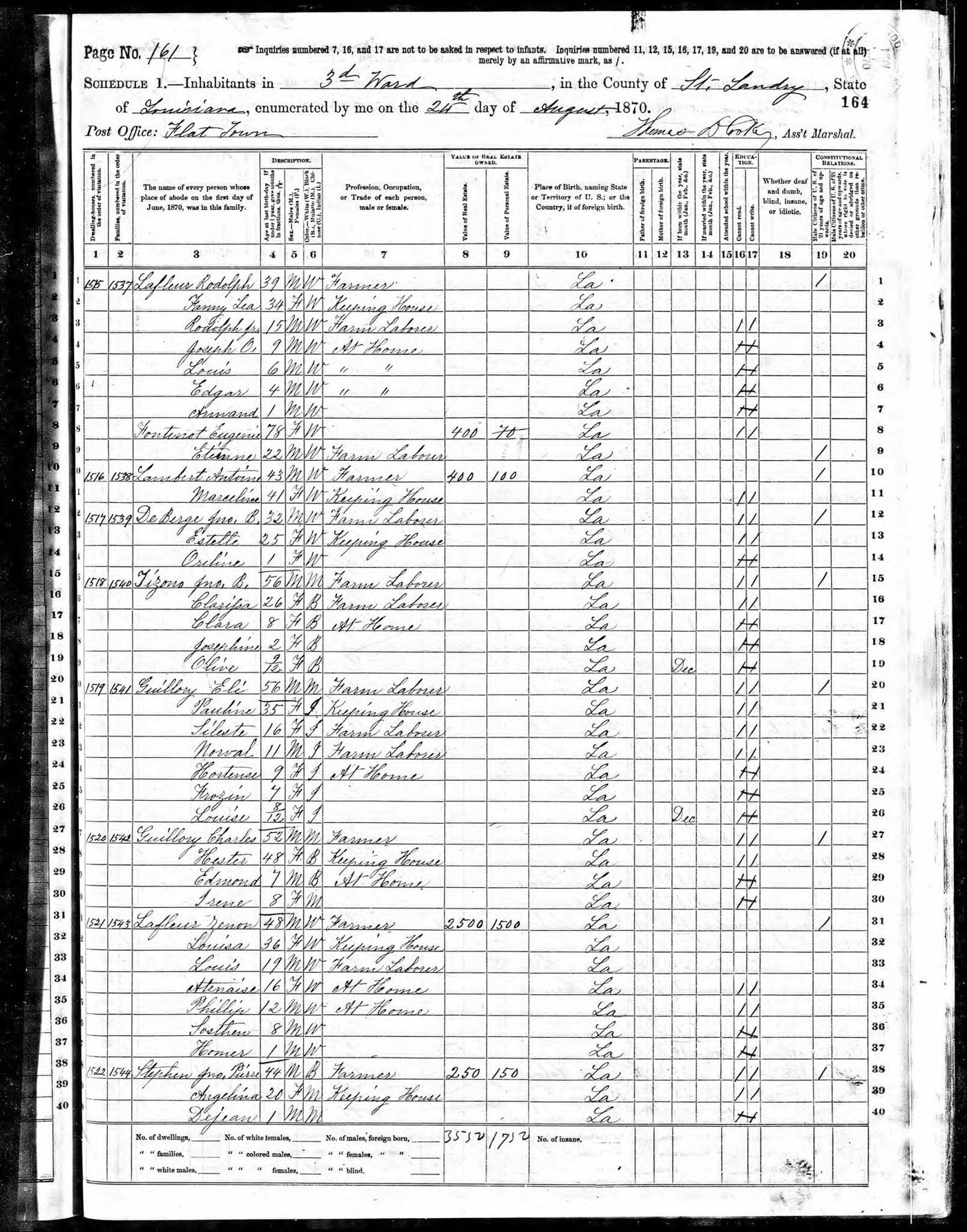
🏹 THE ATAKAPA-ISHAK LAND AND INDIGENOUS FOUNDATION: When people look at our family tree and try to claim we don’t have tribal roots, it’s only because they don’t know how to read the actual documents. They stare at European names like Guillory or LeDay and completely miss the foundation. Let map this out straight so there is no room for doubt about exactly who we are. Our Atakapa-Ishak heritage doesn't come down through paternal European lines; it is carried by our grandmothers, and Marie Louise Césaire (Ellen) is the absolute anchor of this bloodline. Because our family stayed deeply embedded in the same local prairies, her blood loops back into the tree from both sides. On the LeDay line, tracing up through Alsay LeDay Sr. and Louis Evêque Lede, you hit my 4th great-grandmother, Marie L. Guillory, the direct great-granddaughter of Marie Louise Césaire (Ellen) and Joseph Gillery. On the Papillon line, tracing up through Edgard Savinien Papillon, you hit Marie Felonise Guillory and her father Elphege Guillory Sr., whose mother was Heloise Chevalier dite Meuillon, the direct granddaughter of Marie Louise Césaire (Ellen) and Joseph Gillery. Because my great-grandparents were double cousins, both sides of the tree converge right at the same spot. Marie Louise Césaire (Ellen) is my double ancestral grandmother. We have 20 documented kinship intersections showing how the LeDay, Guillory, Papillon, Hardy, and Allain lines continually tied back into each other to preserve our community, our land, and our identity as an intact, unified enclave. Our indigenous history is multi-layered; look at the 1870 Federal Census ledger for St. Landry Parish, Household 1519, where the family of Eli and Pauline Guillory down to the youngest children are explicitly marked by the government marshal with a clear, capital "I" for Indian. The paperwork struggled to capture us—calling us Native, Mulatto, or Creole depending on the decade—but the signatures don't lie.
True Creole culture is the living definition of resilience—a rich blend where French, Spanish, Italian, African, and First Nations cultures collided, adapted, and forged something entirely new. If you look at who I am, I am built exactly like a classic Louisiana gumbo. My lineage is a rich roux, simmered over centuries, beautifully mixed with various cultures, flavors, and histories.
Clayton Antwan Williams
Published on July 12, 2026. All rights reserved.
First shared on Facebook, October 12, 2026.
The Documents
Sources
Guillory v. Fontenot — the settlement of April 5, 1783: Marguerite and her children secured their freedom for 600 pesos.
Last will and testament of Martin Donato Bello, 1847.
The San Ignacio de Loyola crossing — Antonio Vicente Dominguez, Tenerife to New Orleans, 1778–1779.
1870 U.S. Census, St. Landry Parish, Household 1519 (Eli Guillory family).
Researched from the original records. Prepared with the help of AI — the documents, the citations, and the history are real.
The documented work is shared as it surfaces on Facebook.
© 2026 Clayton Antwan Williams. All rights reserved.